This photo was taken later in the day on September 13, 2008. It is the complex where my daughter lives. Fortunately for her she didn’t live in the building that burned to the ground. The TL120 was the camera used.
This photo was taken later in the day on September 13, 2008. It is the complex where my daughter lives. Fortunately for her she didn’t live in the building that burned to the ground. The TL120 was the camera used.
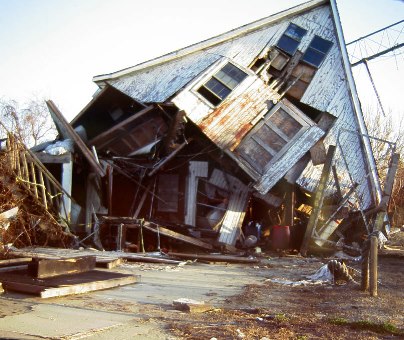 Hurricane Ike was the third most destructive hurricane to ever make landfall in the United States. This photo was taken on Bolivar Peninsula in December 2008. It is actually one of the few structures that wasn’t totally washed away. The camera used was the TL120.
Here is a link with more photos in 2d: http://www.boston.com/bigpicture/2008/09/the_short_but_eventful_life_of.html
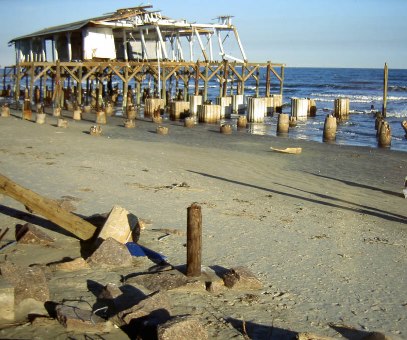
Hurricane Ike roared through Texas on September 13, 2008. Its path of destruction included Galveston Island and Bolivar Peninsula and Houston. Bolivar was nearly flattened, few structures remain. The Ballinese Ballroom was a Galveston landmark. Frank Sinatra even performed here! Here is a link to this famous ballroom built in the 1920’s: http://balineseroom.net/historyofBalinese.htm
The TL120 was used for this shot.
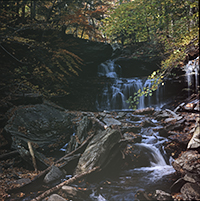
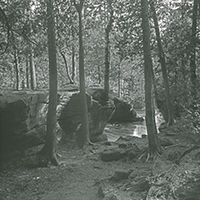 James is a new participant from Canada and has submitted two of his images for our enjoyment. The first (as seen on the left) is from Rockwood, Ontario and the second is a color image from south of the border in Rickets Glen, Pennsylvania.
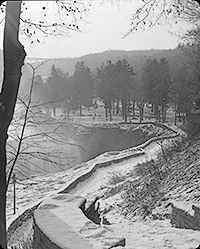
 Matt has two images to share with us this round. The first is from Letchworth, New York and was created with Scala in his Sputnik at f/22. The second was created on Provia 100F in his Sputnik at f/22, but is from Albion Falls in Hamilton, Ontario.
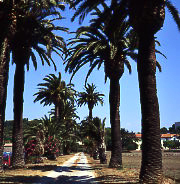
On the south coast of France in the middle is Hyères near Toulon. Shot with a Sputnik.
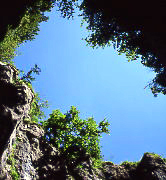
This cave is on a path high over the city of Geneva. As we entered a bunch of small chamois goats scooted out. Sputnik shot in 2001.
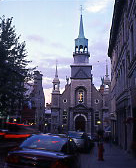
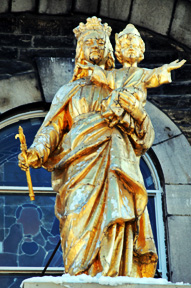 In old Montreal, photographed using two Mamiya C-330 cameras with 65 mm. lenses on a Manfrotto tripod. I used a twin cable release to trip the shutters in near synch. Notre-Dame-de-Bon-Secours (“Our Lady of Good Help”) Chapel, a church in the district of Old Montreal. One of the oldest churches in Montreal, it was built in 1771 over the ruins of an earlier chapel. In 1849, Mgr. Ignace Bourget, Bishop of Montreal, gave the chapel a statue of the Virgin as Star of the Sea, which was placed atop the church overlooking the harbor. In the 19th century, the chapel came to be a pilgrimage site for the sailors who arrived in the Old Port of Montreal; they would make offerings to the Virgin in gratitude for her “good help” for safe sea voyages.
The close-up on this page was taken with a NikonD300 with a 55-200 mm VR lens. f-8 200 mm 1/250 sec.
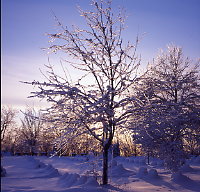 I noticed Dale Walsh also likes photographing in Mount Royal Cemetery, an oasis of calm in the middle of Montreal. Freezing rain covered the trees with ice and then a snow storm blanketed the tombstones. I like the way the trunk hides the sun in the left image, but it peeks out in the right image.
Original slide shot December 14, 2008 with a tripod-mounted Heidoscop with Provia 100P at 1/50th at f22.
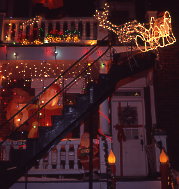 Wrought iron staircases are typical of Montreal, and I like the way Santa parked his sleigh on the top of the wrought iron staircase in this tableau.
Original slide shot December 13, 2008 with a tripod-mounted Heidoscop on Provia 400X exposed for 2 seconds at f22 with fill flash.
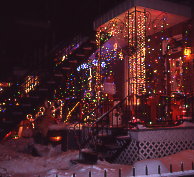 Most of the homes in Verdun are simple brick rowhouses that all look much the same. With limited opportunity for originality in the architecture of the home, the people of Verdun go wild decorating their homes at Xmas and Halloween.
Original image shot December 13, 2008 with a tripod-mounted Heidoscop on Provia 400X exposed for 2.5 seconds at f22 with some fill flash. (There is no flash sync on the Heidoscop so I just set off the flash during the long exposure.)
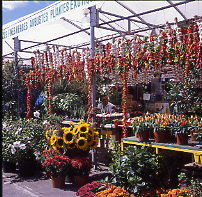
Original slide, taken August 31, 2008 with tripod mounted Heidoscop on Provia 100F at 1/20 at f25.
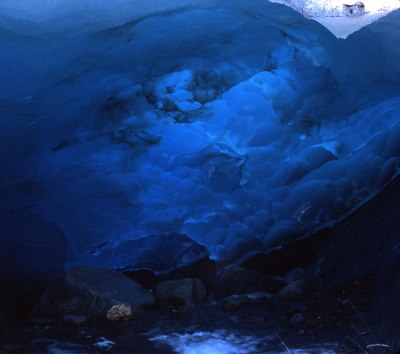
Note the rock with white-quartz knob
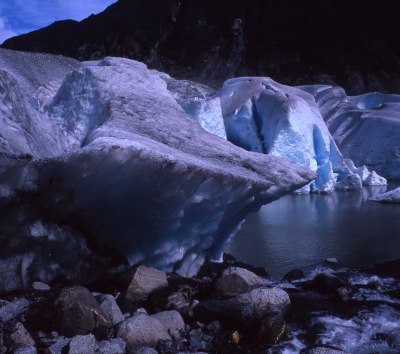
The top of that rock is in the lower right corner
While I know that all four of my images in the last loop from the Mendenhall Glacier, it is where my camera has most frequently been pointed in the past year. Experiencing the changing ice and witnessing the emergence of fresh ground is thrilling.
Back in June of 2007, I stood in the middle of a stream which had torn a hole in the side of the ice. The water was disappearing into the darkness under the glacier as it ran out to the lake. It was a bit disconcerting to make my way down the rock-face so I could stand in the stream of snow-melt and make the image. It would have been a wet, hypothermic climb had I been knocked down and over the edge 😛
A little over a year later, I stood in the same stream and was stunned by the change. I attempted another image from the same location as before, but found the composition totally boring. Instead, I brought the camera forward about eight feet. This was still in the stream, but my tripod had better footing and the composition had some foregound interest and receding lines. By chance, a rock from the earlier image is present in the lower right of the later image. It helps give an idea of how much has changed.
The first image was shot with my TL120-1 while the second was shot with my wide-angle TL120-55. Both cameras were tripod mounted.
Both images are mounted in 46x52mm (MFW) mounts from Rocky Mountain Memories. I really like the mount. The aperture is 2mm wider and 6mm taller than the normal 40×50 (MFL) mount. Give them a try if you can get your hands on any.
TL120-1 on a tripod
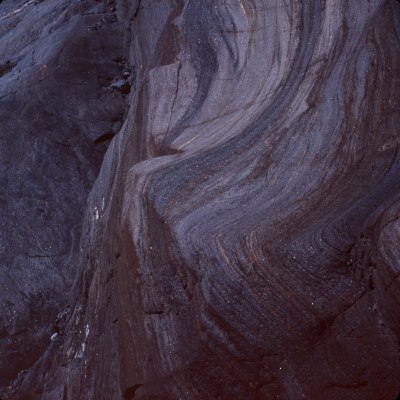
As my previous submission to the folio demonstrate, I have been exploring the freshly exposed ground left by the retreating Mendenhall glacier. What I find are features, shapes, textures and colors which have been exposed to us for no more than ten years. In some cases, the rock has exposed in the previous month and my feet and hands are some of the first things to touch the surface since the ice left.
This is a texture, shape and color study. I am fascinated by the sparkling mica and quartz, the conflicting contour lines and rock layers, and by the macro-scopically smooth shapes which closer study shows to be an extremely rough surface.
It was shot with my TL120-1 (so 80mm lenses) which was tripod mounted. I made exactly one exposure, but I’m pleased enough with the results that I want to make more.