My son Vincent summer before High School Freshman
My son Kevin summer before Freshman Year at College
 He’s going to Elon University, North Carolina and will run Division 1 for their cross country and track teams. He was a 4:15 high school miler.
Variegated Century Plant (Agave americana ‘Variegata’ )
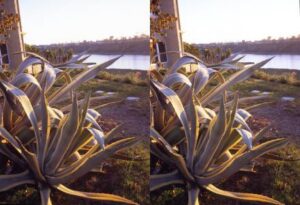
Matt Infante D27 Submissions
Hi All,
This is my first submission to the Dragon folio. Thank you Ian for inviting me. I had a wonderful time viewing the slides in the folio.
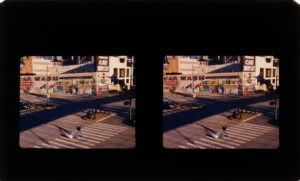
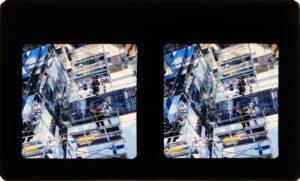
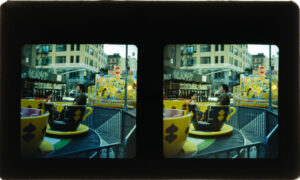
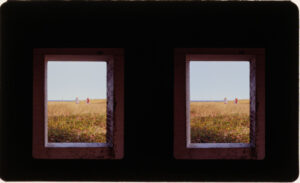
I live in New York City and have been practicing stereo photography since 2018, specifically MF3D since 2020. These images are from 2021-2023. Three of the slides are scenes in and around NYC. The fourth image of the window looking into a field was photographed in a lighthouse in Nantucket. The teacup image and mirror reflection image were made with a TL120. The image overlooking the Westside Highway and the lighthouse image were made with a twin Yashica-D rig on a slide bar. All of these were shot on Kodak Ektachrome 100.
I generally go for natural scenes that lean more towards documentary photography/street photography, but I also love making portraits of people, which I’ll include more of in the next round. I love waning light and reflections. For this first submission, I chose these just to give a little variety, not just in the subject matter, but also in the technical ways the images were made. The fun facts behind some of these are for the mirror scene, I was hired to document the final construction of “Summit”, which is a multi sensory art installation atop the One Vanderbilt building next to Grand Central. It’s essentially a two story Kusama infinity room on steroids. Lots of 3D eye candy on that project. Also, yes the teacups were actively spinning in that shot. I attribute my brief time as a focus puller on film sets to being able to time the moment correctly at what I think was an F4.
Ruby Pop
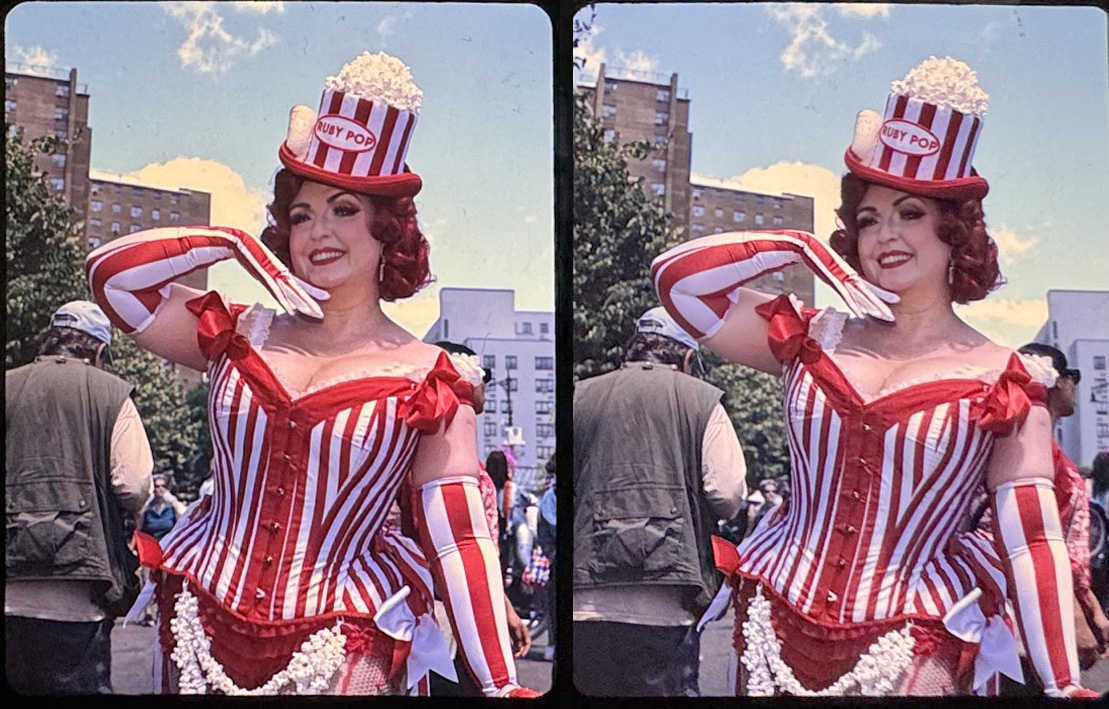
Also from the 2026 Coney Island Mermaid Parade. TL-120 handheld 1/125 @ f16. Canon 600EX flash at half power. I hadn’t used the Canon flash with the TL-120 before, the internet told me that it put out twice as much light as the Vivitar 285H and it worked well using the settings I was accustomed to divided by two.
Cecily Starr
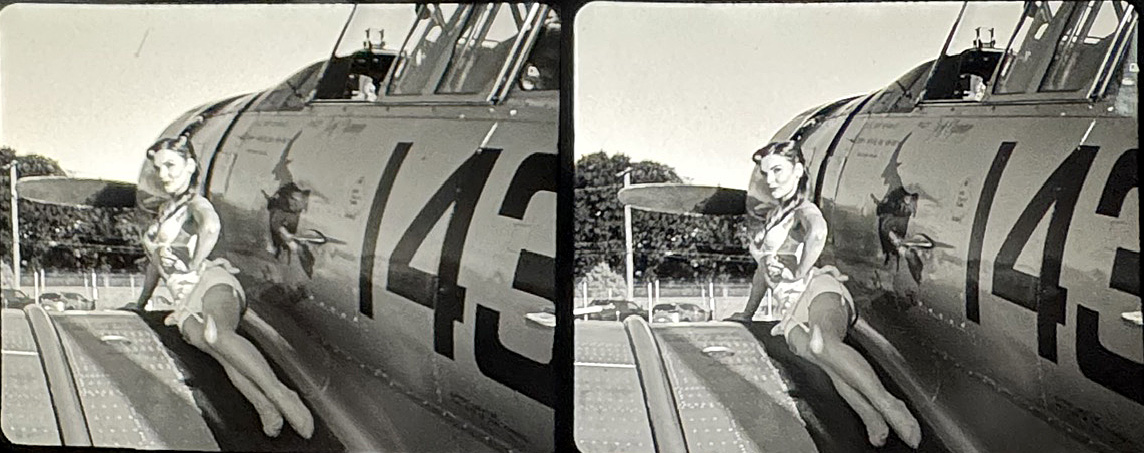
This was from a 2021 New York Pinup Club shoot at the American Air Power Museum in East Farmingdale NY. TL-120 with Vivitar 285H flash. I shot with Ilford PanF black and white print film and had the reverse processing done by DR-5. I’m not sure if this was one of the last runs they did, as I recall it took a few months to get the processed film back.
The Findyhoppers
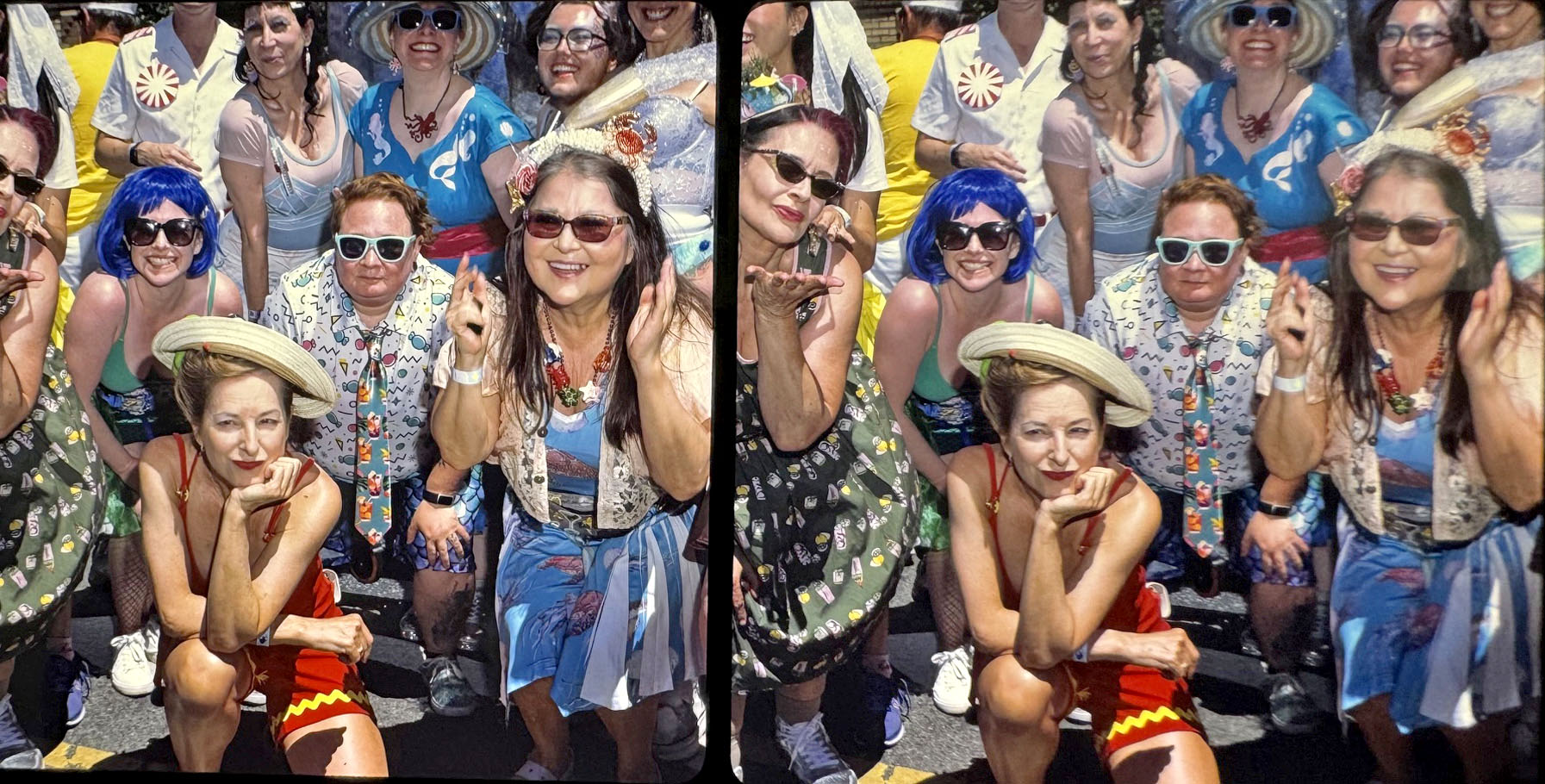
Once again from the 2026 Coney Island Mermaid Parade. I haven’t been doing much MF3D shooting lately but I decided to bring my trusty TL120 along for this year’s parade. While shooting I felt the lens board shifting a bit. After the parade I discovered that the lens board screws were getting very loose and one was missing. Fortunately none of the slides I took were affected by this and I tightened everything up.
The Findyhoppers are a group of dancers who I often see at this event, I have years of 3D photos and videos of them rehearsing in the staging area. For this group shot I used a Canon 600EX flash at half power, which matches the full output of the Vivitar 285H I’m used to.
Nathan’s Fries
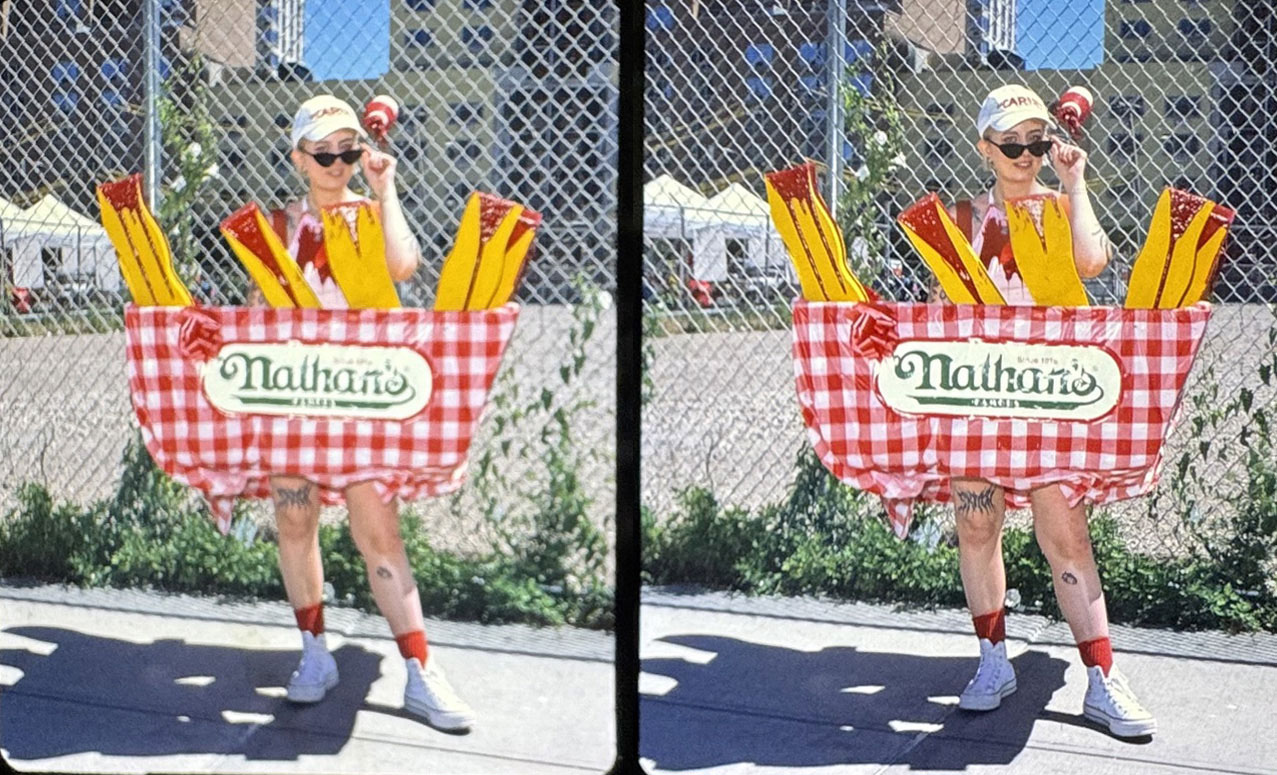
From the 2026 Coney Island Mermaid Parade. TL-120 with Provia 100F pushed one stop. Handheld, most of the day I shot at 1/125 using f16 or 22.
I used a Canon 600EX flash at full power here – this is twice as much light as the Vivitar 285H I’m used to using with this camera. Without the flash our fry lady’s face would have been mostly shadows.
Zach Horton’s A35 Submissions
I’m traveling at the moment and can’t dig out the original scans of my submissions, so a snapshot I took of all four together will have to suffice…
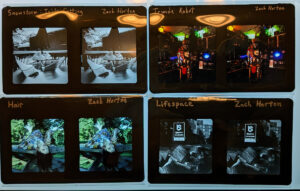
Lifespace
From Summer 2025 in Pittsburgh, when the power company chopped down two blocks worth of large trees without warning. This event caused a massive community uproar. During a walk, I happened upon the stumps before they had been removed. I was out testing a prototype Mercury 6×12 film back, and only had ancient, expired, low-grade BW film loaded, but was pleased with the ironic result.
Shot on a Mercury Stereo 12, on unknown film. I believe this was with a Mamiya 105mm lens. Slide made via the M-Chrome process.
Snowstorm: Table Setting
From this January, during the largest snowstorm we have received in Pittsburgh in 15 years. Shot on Ilford HP5+ film, pushed two stops to ISO 1600. Shot on a Mercury Stereo 12 Pancake, an ultra-thin version of the camera normally used to shoot Instax 3D, but in this case I was testing out a radical lens: the Schneider APO-Digitar 35mm. This is widest lens I’ve ever tested in MF3D. I welcome your feedback! I haven’t had a chance to shoot more with this lens pair, and can’t wait to do so!
This is an M-Chrome made from the BW negative.
Hair
I shot this last spring with a fantastic model, Helena. It is part of a series of experiments with the Mamiya 105mm lens, which quickly became my favorite portrait lens for MF3D!
Shot with a Mercury Stereo 12, on 70mm Portra film. Slide made via the M-Chrome process.
Trundle Robot
This was shot at a curiosity museum in Pittsburgh. This wild robot sculpture was standing in a corner. With great effort, the owners of the museum, Vicky, and I hauled it out to pose it here, I’m sure for the first and last time.
Shot with a Mercury Stereo 12, on expired Fuji RMS slide film, using the Schneider Super Angulon 47mm lens.
Selene
Sorry, I must rest on my laurels this round; these two views of Selene were obtained ten to fifteen years ago(!), the one in the kitchen in natural light with a Sputnik for sure… the one with mirrors in studio probably with the Sputnik, alternately maybe with my Mamiya 6 twin rig, and using a strobe kit for illumination.
The shot with the mirrors was part of a series of images exploring the difficulties people sometimes have in seeing themselves as beautiful, or even just acceptable. I wanted to get models to draw themselves on a mirror, easily just following / tracing their reflection using a grease/wax pencil. The plan had been (actually, still is) to find a very skinny/anorexic model, and have her draw herself as quite fat in the mirror. I’ve not yet found that model, but in the interim got some pretty good pictures with Selene and one other model using this mirror situation.
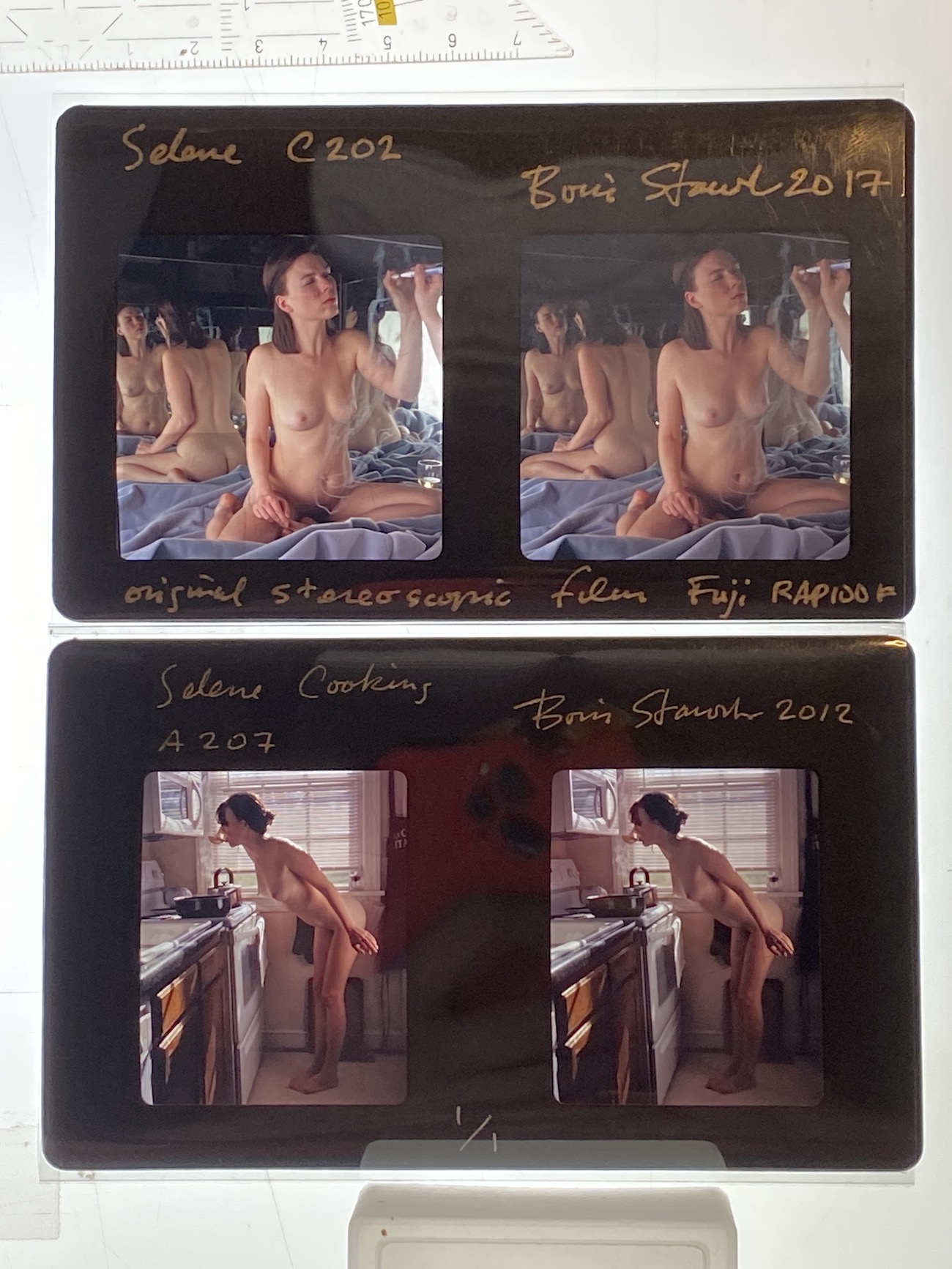
The kitchen view was inspired by the back-lighting that we got every morning, with sunlight streaming over the stove, lighting up steam etc. as one might cook breakfast. Selene was happy to oblige my desire to add some spice to this visual recipe.
Subbasement IX (two views)
Aeons ago, when I first started shooting MF3d, I set my sights on an abandoned textile mill in downtown Charlottesville. Frank IX & Sons made various textiles there until 1999. What’s amazing to me is that, though I lived in the area, and would have cycled past it almost every day in the mid to late 90’s on my way to work, I was completely oblivious of its existence until after the turn of the century, when I was looking for things to shoot in MF3d. Only now, having read some history on it (for this post!), do I realize that when I took these pictures, the mill must have been shut down just one or two years prior. Indeed, just a few years after my several photo expeditions there, the building was nearly completely removed, and what remains of it is now the centerpiece of an art park, including two breweries (one for sake, the other for beer) and some other social gathering places.
Anyway, on to these two pictures… I had done some exploring and photographing in the vast main hall and then continued to poke and probe ever deeper into the ruins of this structure. At one point I saw a hatch in the factory floor, with a steep ladder descending into blackness. Of course, I had to check that out! At the very bottom, in the faintest of light, I discerned the most amazing scene: a basement, or maybe it should be called a subbasement, that was completely flooded with water. Using a tripod that could hold my cameras very close to this watery surface, I was able to obtain images of the room, where everything above the water was perfectly reflected in the water itself, creating this symmetrical surrealism.
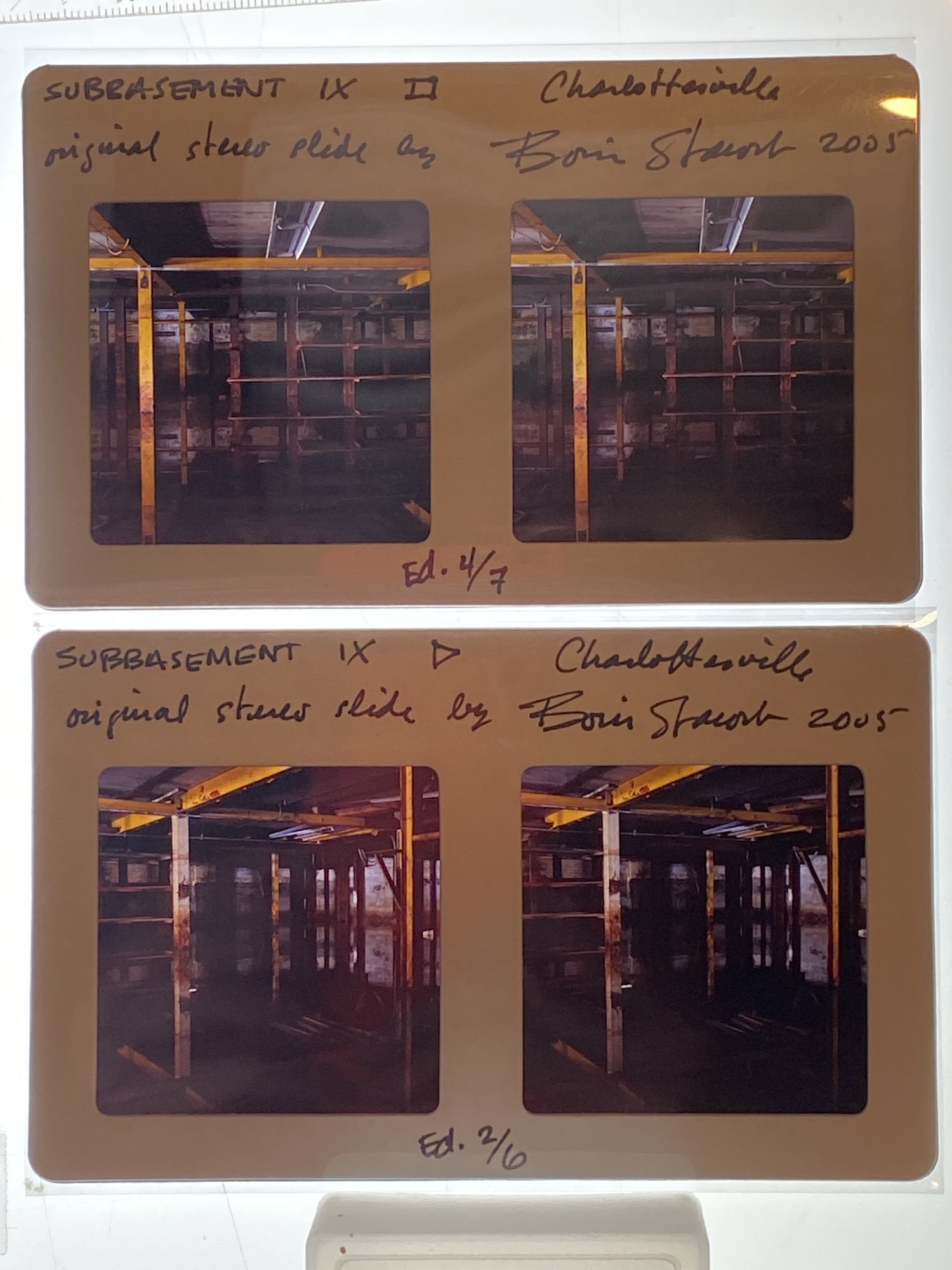
I think this “early” MF3d work was shot with a Sputnik borrowed from my friend Chuck Holzner (RIP), with whom I’d gone to the Buffalo 3D-con the year before? (around 2000) Shot at probably f22, with at least a 30 second exposure time, maybe more… I can recall only that I was worried about reciprocity failure in this film, but that I did not know the numbers. The only light source was a small window far to the left, that opened onto some kind of light-well. The slide gives you a view such as you would experience only with dark-adapted eyesight.
Steven Lederman’s Congruent Slide Set, Loop 35

Recently I experienced the misfortune of my last 3D World mounting jig falling into a state of disrepair. I have been capturing a lot of stereo images lately, but without a reliable way to mount said images I was forced to dig through my archives. I wanted to present a set of images that made sense together, that told a cohesive story. I finally came up with the selections submitted here. The four images share so much in common! First, they were all shot on film! Second, they’re all mounted using cardboard mounts! Third, they were all captured with a camera of some kind, and fourth, they all have some sort of writing on the mounts themselves! Incredible! I had no idea that I had been unconsciously photographing images with these similar themes, and that I was building such a coherent body of related work!
“Queen Kong – Trestle”
Most of the band Queen Kong performing in 2021 on the back patio of Trestle Brewery. Shot with a TL-120-1, probably on Superpan 200, which I reverse processed myself using a Jobo unit.
“Queen Kong @ Trestle Brewery”
The rest of the band Queen Kong performing in 2021 on the back patio of Trestle Brewery. Details the same as above.
“Clown Cars”
A semi-successful cha-cha captured somewhere in Connecticut (I think) using a Fujifilm GA645W Professional with a 45mm lens. Looks like expired Fuji stock. Home processed with a Jobo unit.
“COGNITIVE”
Photographed in 2022 in Lansing Michigan using a TL-120-55. I believe the correct name of this sculpture is “Portrait of a Dreamer”. The interactive parts of the sculpture were partly broken when I made this image, if I recall correctly. Looks like expired Kodak stock. Home processed with a Jobo unit.
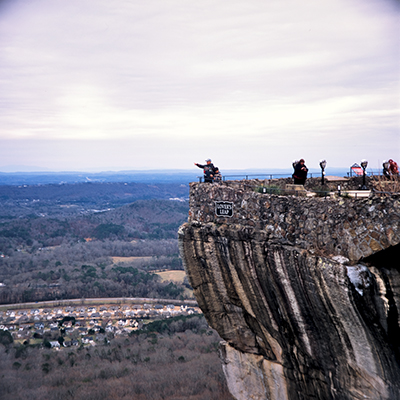
‘Lover’s Leap’ – Rock City, Georgia 2025
My father moved to upstate Georgia back in 2023 and wanted me to come out for a visit. It’s an interesting part of Georgia, with lots of historical Civil War battlefields, southern cuisine, and of course, Rock City. Rock City, which houses Lover’s Leap, is by far the most obnoxiously advertised amusements in the country. It’s ‘See Rock City’ slogan was painted by 1969 on more than 900 sides of homes, rooftops, billboards, etc. It’s slogan is especially noticeable within a 20 mile radius of the actual park. It’s actually a pretty interesting place to visit, despite it’s annoying slogan (in which my father fell victim to, hence our visit). From the top of Lover’s Leap, one is said to be able to see 7 states from one viewpoint on a clear day. This includes Tennessee, Virginia, Alabama, North & South Carolina, Kentucky and of course, Georgia.
Lover’s Leap refers to the act of two lovers jumping to one’s demise to avoid conflict and/or separation of said lovers rather than deal with any issues at hand. Sounds romantic, no?
Rock City was built on top of Lookout Mountain, back in 1935. A gentleman named Garnet Carter and his wife started monetizing the visit to the park in which they built over 4100 feet of walking trails over 700 acres. That trail ends at Lover’s Leap. We managed to clamber over most of the place, but found it to be a bit exhausting. All in all, it was a good place to shoot 3D. If you’re aware of it’s slogan, you may have already been there with it’s enticing ‘See Rock City’ slogan etched in your brain. Shot with my Sputnik, 60th/sec. at f.22. Provia 100f Fujifilm.
Coronado Historic Site, New Mexico 2025
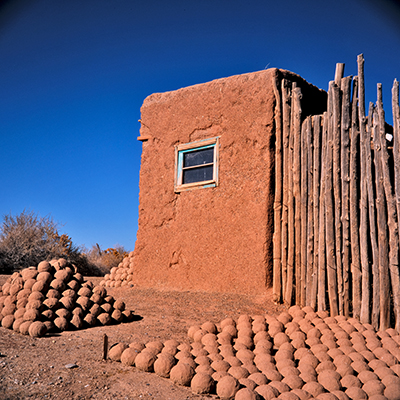
My wife and I visited her sister in Albuquerque last year. We had always been curious to see that part of the country. We liked it, but still love the fresh green trees of the Pacific Northwest more. After visiting, we do understand some of it’s magnetizing aspects. Native American art and heritage, unique architecture, and it’s quirky and fascinating history. All in all, I was not totally happy with most of the shots I took there, and I only shot about 2 rolls while I was visiting. So, needless to say, I didn’t have a lot of shots to share. This is a shot of a maintenance building that was built using the same methods as what the original buildings would have been built with back in 600AD. Except for maybe the added window frame of course. The balls you see there are called ‘armas de la tierra’ or ‘weapons of the earth’. This was a Tiwa people’s ancient adobe construction technique. They would use the balls to build walls while they were pliable, thus becoming hardened and sturdy after being dried in the sun.
Coronado is located near Albuquerque and the mighty Rio Grande River, and has been around since at least 1000BC. Everything was fine and dandy until 1540 when a group of European colonists visited and fought with the populace in trying to find gold and silver in the region. None was found, and the expedition was ended in 1542. It was colonized from 1542 onward. Conflict and disease led to a downfall after the Pueblo Revolt of 1680 and the town was abandoned. It was later designated as New Mexico’s first State Monument site in 1535. Not much is left of the site, hence the picture of the work shed instead of the ruins left behind of the village. I found the work shed to be more interesting to photograph. Shot with my Sputnik, 100th sec., f.22, Bright sun! Provia 100f Fujifilm.