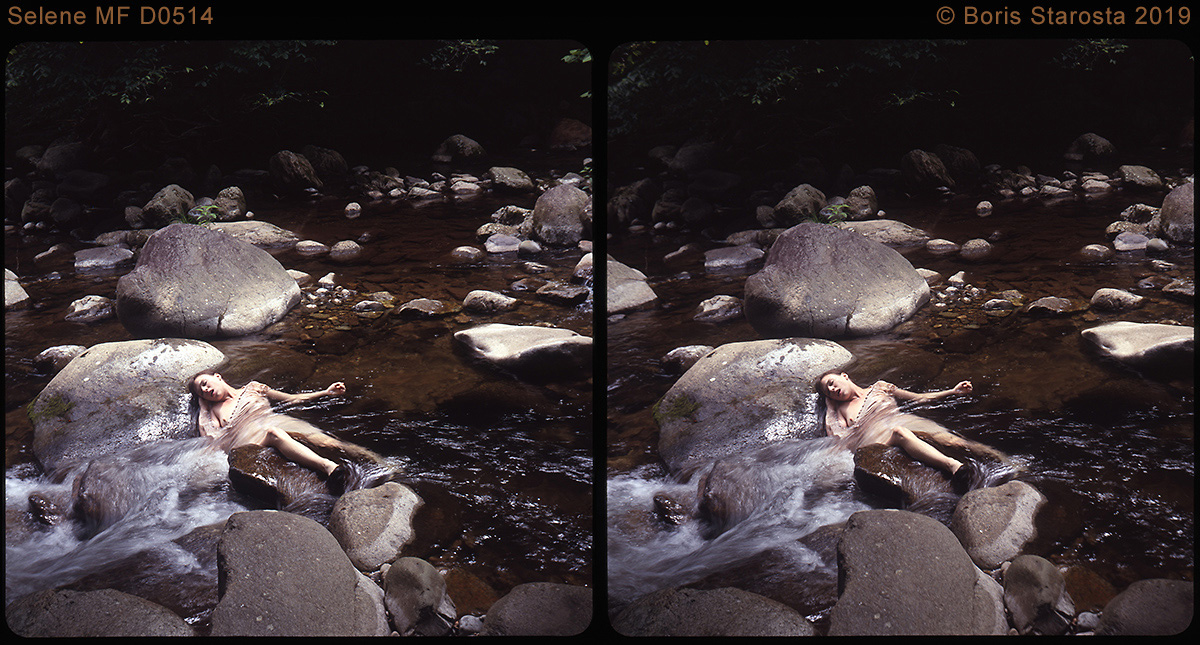
I’m not sure what to title this shot. I’m not sure what exactly I’m doing with this composition or concept. About five years ago, a vague creative idea started to form in my mind, that intended to be a “challenge” to glamour imagery in general. The idea was to create nominally pinup, or nude, or glamour type imagery, but to embed into the image something that was disturbing. It might be an an odd or disturbing detail that would upend an otherwise tranquil scene, an “easter egg” that would only be discovered if you explored the image relatively carefully and closely. Or it might be an image that more directly challenges the conventions of glamour photography, or that shows in some other way the “truth” behind a model’s reality, which might be quite the opposite of what the picture superficially conveys. This project is naturally self-referential and introspective, as it examines my own critical thoughts on the nature of nude or erotic image making, what it means for the artist, the model(s), or even the audience… and by taking that examination directly to the audience, I hope to challenge the audience to examine itself.
So this picture of Selene is one of several attempts I’ve made over the past few years at creating a “glamour challenged” or “challenged glamour” type of image – I’m still finding my way in this project, and can’t say that I feel any of the resulting images so far are particularly successful. I am still dissatisfied with them.
The day began with Selene and I looking for some pretty, natural spot in which to shoot, and after some hours, we ended up at this river not too far from the roadside. We set up and shot numerous standard or ordinary nude and semi-nude images of her posing among the rocks in this little river. She knew that in the end I’d be asking her to be getting into the water, but by the time that moment came, she was reluctant – she’d already noticed how cold the water was, after having put her foot into it several times. But she was a champ, and finally took the plunge. She gave quite a shout upon first entering the water, but then concentrated on giving me some poses. I had wanted her to look both “attractive” but somehow in trouble, distressed or drowning (?) in this river – and I thought she came up with some passable looks. I think we were both surprised by how she hardly needed to act looking uncomfortable, or indeed of distressed. As we quickly learned the water was indeed brutally cold, and after only thirty seconds to a minute, she needed to come out. I wrapped her in blankets, shivering violently, and it took her probably twenty minutes to recover from this seemingly innocuous dip in the water.

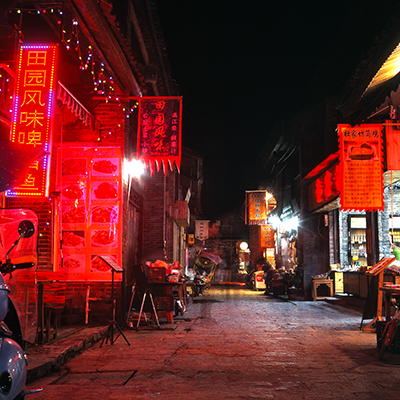 They say that ‘Guilin is the best scenery in Guangxi, and the best of Guilin is Yangshuo.’ There is no doubt that Yangshuo is a beautiful location in the world with it’s limestone Karst mountains and gorgeous waterways. I would highly recommend a visit. An added bonus is it’s little walkways and side streets such as this one at night. Mostly catered to tourists ( as most of this area is, for good reason), it’s an interesting area to visit. I enjoyed being able to safely take night shots throughout the town, and this shot being one of my favorites. Shot with my Sputnik MF3D camera on Fujifilm Provia 100f film.
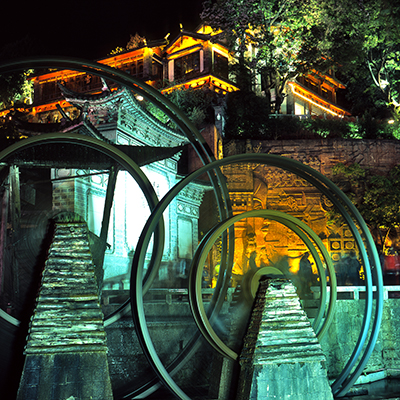 Here’s another shot of Lijiang at night, of the famous waterwheels located in the south entrance of town. The water wheels were supposedly built roughly 800 years ago, around the time of the town’s origin. I wanted to capture the wheels in motion, so a nightshot it was to be! I enjoyed Lijiang immensely, despite the amount of tourists at any given time. The town has so much to see that it’s no wonder that it was so popular. Not to mention that I was there in the perfect time frame for weather. Shot on my Sputnik MF3D camera and shot on Fujifilm Provia 100f fim.
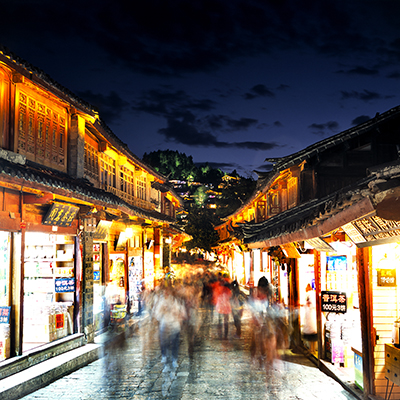 Lijiang is a beautiful city located in the Yunnan province of southwest China. A town full of cobblestones, old houses converted into hotels and storefronts, waterways and bridges galore. It’s no wonder that this town was overrun by tourists, mostly from China, and filled the streets day and night. I wanted to capture it’s beauty and it’s craziness at the same time. I figured a long exposure night shot would do the trick. This was shot with my Sputnik MF3D camera with Fujifilm Provia 100f film.
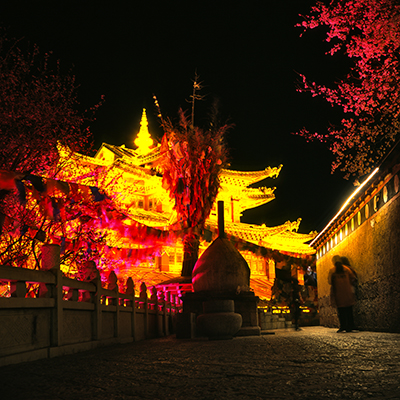 Shangri La is located near the province of Tibet in southwest China, in the Sichuan province. Not many tourists seemed to be there, despite the amount of local tourists in other parts of China. Maybe it was because there wasn’t much to see in the town except one of the largest prayer wheels in the world and a spectacular night time lighting of the local monastery. The town had been devastated by a large fire, destroying most of the original buildings only years prior to my visit. Needless to say, we did not stay in Shangri La very long, only 2 nights, before heading south to the more interesting provinces of Yunnan and Guangxi. Shot on my Sputnik MF3D camera with Fujifilm Provia 100f film.