Zach Horton’s D26 Submissions

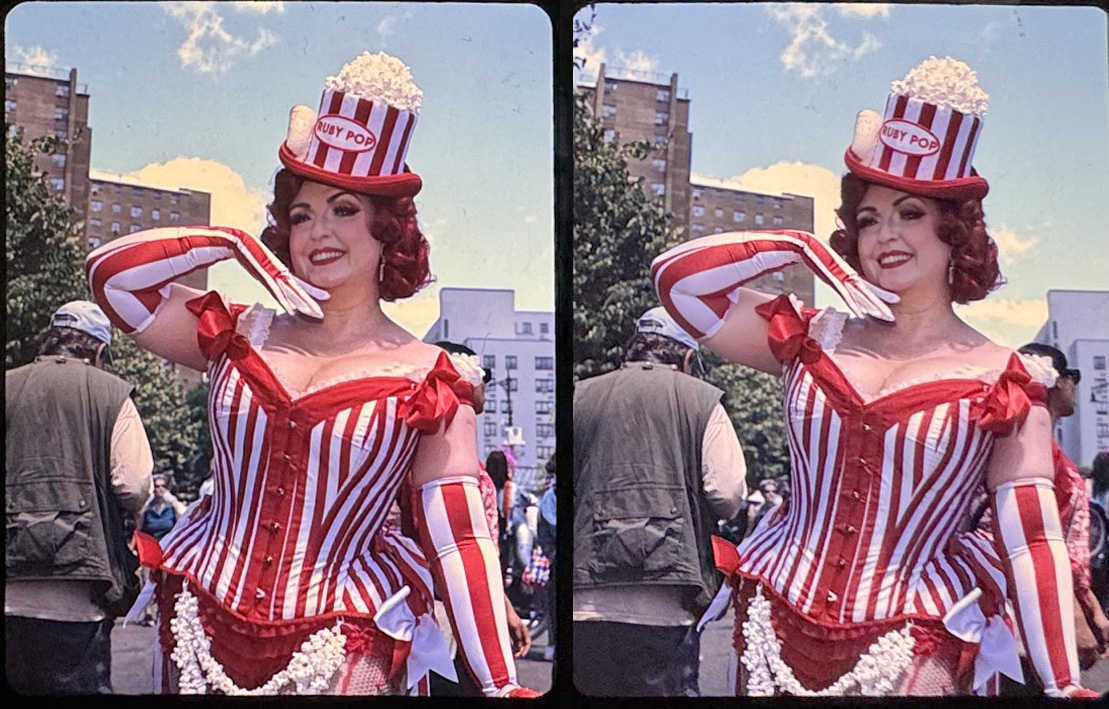
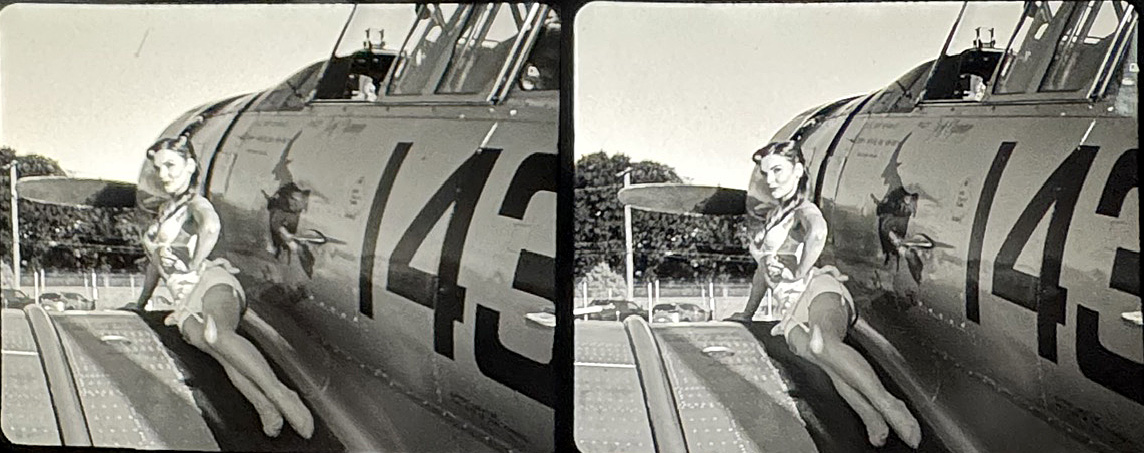
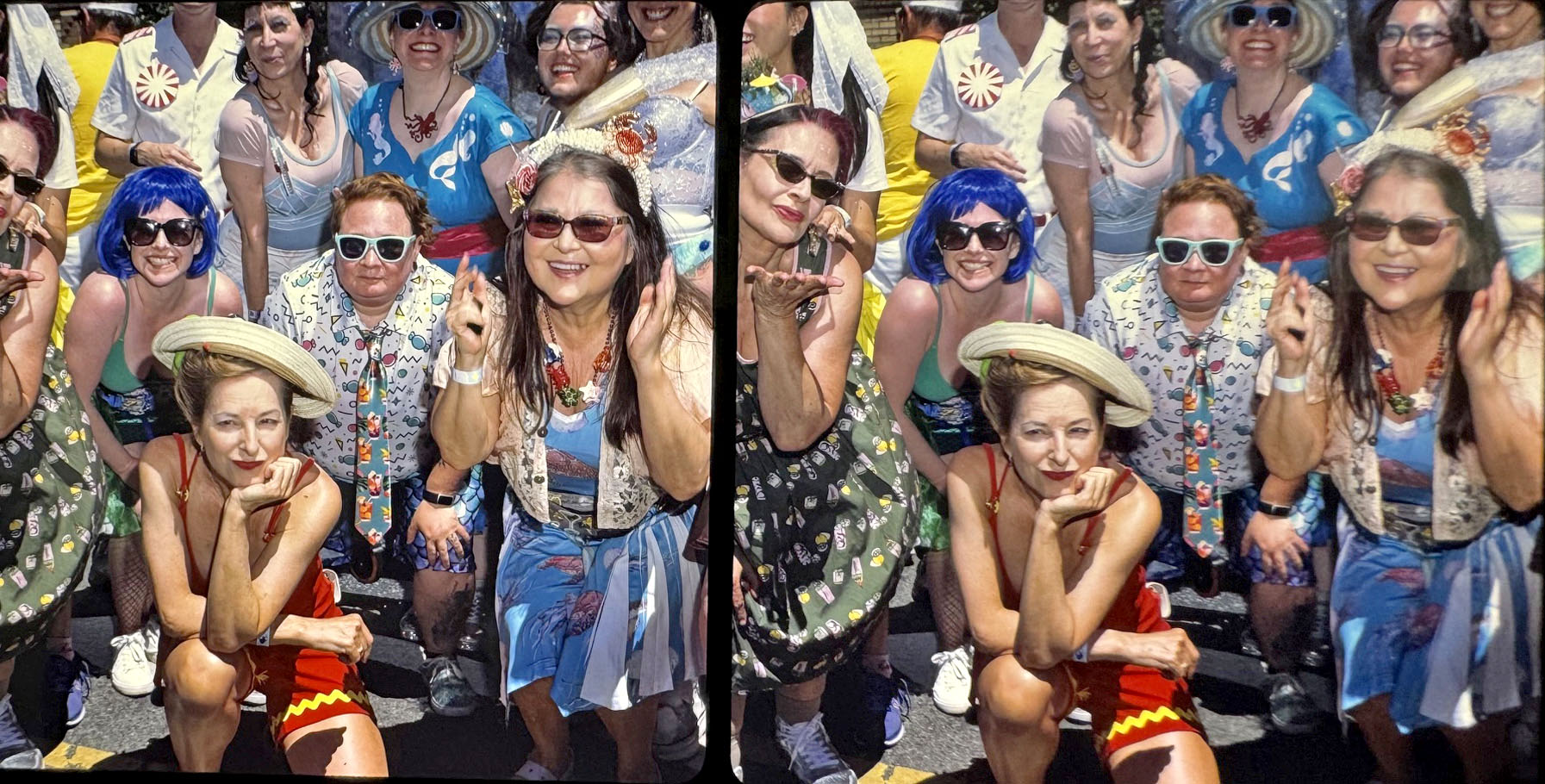
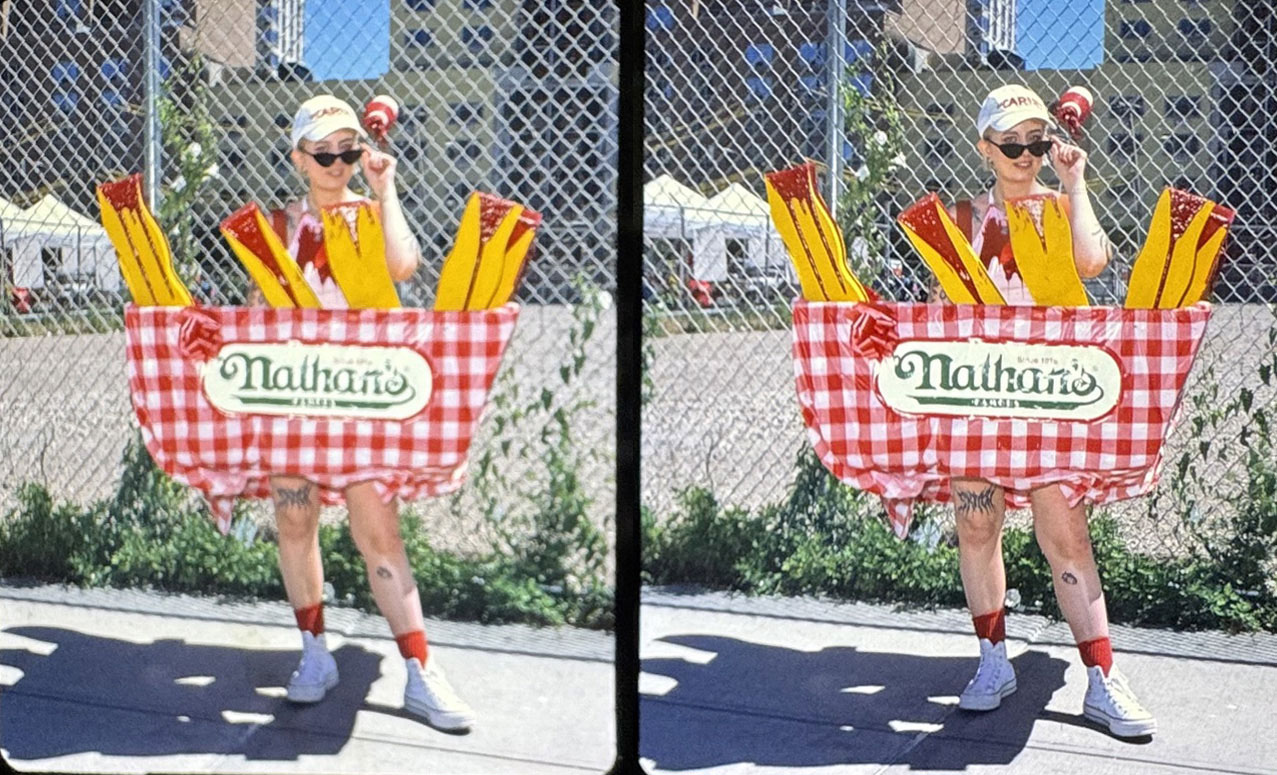
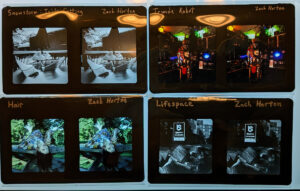
I tried to provide a variety of subjects in this submission. All are taken with a Mercury Stereo 12, with a variety of lenses.  And perhaps most interestingly, none of these are shot on contemporary slide films.  Three of the four are shot on negatives and printed to slides using M-Alchemy‘s new M-Chrome process, while one is shot on 40-year old Ektachrome 64!

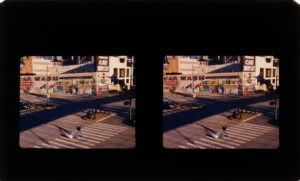
Surrounded

I thought this and the following shot would make a nice diptych! The model is Helena .  This was shot with the Mercury Stereo 12, with one of my favorite lenses: the Schneider Super Angulon 47mm. I’m always looking for the right subject for this fantastic lens! This was shot on 65mm 500T IMAX film and printed as an M-Chrome. The shot contains very bright sunlight as well as deep shadows. No slide film could have captured this, but I was pleased to see that the significantly higher latitude of Vision 3 film and the M-Chrome process was able to retain a great deal of detail in the highlights and shadows.

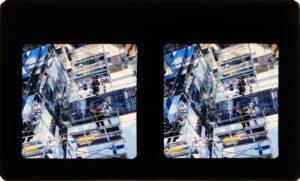
Caged

I shot this on the Stereo 12 with Mamiya 105mm lenses, to get a radically different feel from the shot it’s paired with. I tried to soften the background a bit via selective focus to obscure the fact that I’m slightly exceeding my depth budget. Generally the eyes don’t try to focus on out-of-focus details, but this is all experimental! Let me know how it works for you! Shot on 65mm 500T IMAX film and printed as an M-Chrome. The negative got a little brutalized on this one, adding some scratches.  (The image shown here was a different take than the slide; the slide version is better, but we only scanned this take.)

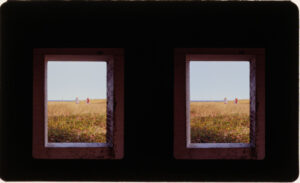
Galapagos Boardwalk

This was from atop Bartolomé island in the Galapagos. On this island, the one that most influenced Charles Darwin, no visitor is allowed to set food on the natural rocks and soil of the island, as part of its extraordinary ecological protection. The result is that when one sets foot on the island, one must walk from the dock to the boardwalk seen here. A trail then wends through the peaks of the island in a large loop. From this vantage I was able to capture the somewhat strange sight of the boardwalk, as well as a cactus-like plant that I had never seen before, but found alien and beautiful. Taken with my Mercury Stereo 12 on Kodak E100 film with Mamiya 80mm lenses.

Visitor From Another World

[Image missing for now–will find and add later]

I watched this amazing fungus grow for several months before finally taking this image. I used a Rollei 6006 to shoot this as a sequential macro, as I had it loaded with special 65mm Double-X film (made specially for the movie Oppenheimer, and given to me by the folks who worked on that film) for another project. This was partially a test of the Mercury Stereo Toolkit app for MF3D, to see if real world results would vindicate its calculations for macro 3D. I think it nailed it! This is an M-Chrome. I discovered that Double-X BW film makes really spectacular M-Chromes. I shouldn’t have been surprised: it is a negative film designed specifically to make film prints! 80mm lens.

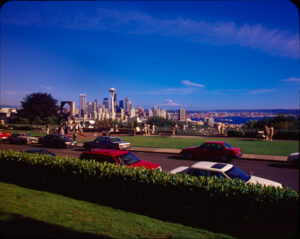
Seattle Space Needle behind Ferris wheel

Photographed with twin YashicaMat 124s. I got some nice images with this rig, it was great for slight hypers like this one. Unfortunately I never figured out how to get both shutters to fire consistently and always had a few wasted shots on any pair of rolls.

Provia 100F pushed one stop. I believe this was a four second exposure at f16.

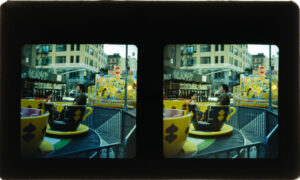
Golden Gate Bridge – San Francisco

This was photographed with a Twin Mamiya C220 rig using 135mm lenses. I quite enjoy the “stretched” effect of slightly hyper telephoto stereo. I had the right camera aimed a bit too far to the right and hadn’t been able to mount this image until I happened upon a sample of Ian’s 127 format mount. This reduces the width enough for me to be able to get a usable window for this shot.

Clear Buildings

I apologize for more architectural views, the second time in a row. These images have not gone around in a folio in over ten years, and I don’t think ever in this folio. Although some of you have seen them before, others might appreciate the views as something new. Also, sorry about the relatively poor sharpness, a limitation of the technology available to me at the time I made these images, almost twenty years ago now.

In the mid aughts I discovered the amazing photography of Michael Wesely, who was then making waves with his experiments in long-exposure photography.  Long exposure times measured not in minutes or even hours, but in years.  His book “Open Shutter” reviews images of architectural landmarks all over the world, where exposure times of up to two years were used to capture the visual abstraction and semi-transparency of architectural transformation.  I was much inspired by this, but I had to know: did Wesely do any of his work in 3D?  Because the images of his that I had seen were supremely suitable for stereoscopic capture, showing as they did incredible complexity, depth, and semi-transparency in structures that were being built or even being torn down.  I had a brief correspondence with Wesely soon after, and his answer was straightforward: he had not shot anything in 3D.

This gave me the green light, as it were.  I am motivated in no small part by applying stereo photography to subjects and or techniques that remain relatively unexplored.  However, in the case of Wesely’s long exposures, I was utterly out of my depth.  I did understand he had used cameras with lenses (i.e. not pinholes) that were heavily filtered.  But I had no way to know how heavy the filtering was, the effect of reciprocity failure in the photosensitive emulsions that he used, and/or how he compensated for those factors.  I knew from the start that at best I would be able to merely simulate his technique using digital photography: capturing images at a given location multiple times over the course of many months (or indeed years), but taking extreme care to position and align the cameras exactly the same way for each image capture, then combining the resulting captures digitally.

Alas, the cameras I was using had “only” 20 megapixels (Canon D60 DSLRs) sensors, with subsequent post-processing and ultimately printing onto film causing further losses in resolution and sharpness. Sorry about that; I know you’re used to much better sharpness in MF3d! I hope the interesting technique and subject matter is an adequate offset to the arguably poor image quality. These film prints were done at a service bureau with a so-called film writer. Nowadays I could probably get better results using my Pentacon MF camera to shoot the images onto film as displayed on a 5K computer screen, but it would take a lot of film and processing to iterate to satisfactory exposure and screen settings.

The biggest building I photographed using this technique of multiple exposures is Ruffin Hall, a new building for the Fine Arts program at UVA.  Over the course of 2007 to 2008 I staked out six different points around the building, from which I captured images.  Of those six, one was lost along the way due to a tractor trailer being placed right in front of my location, blocking the view of the site – but only after several months of construction (and image capture) had already commenced.  Of the remaining five viewpoints, three resulted in quite interesting views, but the one I’m showing in this round is by far the best, because this viewpoint was the closest to the action, obtained from the roof of the neighboring Fine Arts Library.

This image is a simple blend of six exposures taken over the course of some 18 months, with each exposure getting about equal representation in the final mix. This came close to the effect that Wesely had achieved with his ultra-long exposures. But I also discovered that the digital method opened up some creative opportunities that were closed off to Wesely and his wet-process emulsion-based long exposures. I could change the mix, change the transparency of the various images to achieve completely different results.

For example, in this second image of Ruffin Hall, I blended the images to show a progression of time, starting on the left side showing the earlier exposures, smoothly blending to the right side, where the building is shown finished. In-between, in the middle, is that delectable semi-transparent structural complexity that can be appreciated best only in 3D. By a pure lucky coincidence, some men in the middle of the image are conversing, but one pair of the men were photographed at a completely different time than the second pair of men. It looks almost like they are all conversing together in a time warp!

In the many views obtained of this and other buildings in those years, final composition was a matter of luck and some imagination.  Depending on the site and building, I might have had a chance to look at some plans or an architect’s model, and from these inputs, I had to decide on where to place and how to point the cameras.  Two more buildings came out quite well.

Like the Ruffin Hall image above, for a new Nursing School building I blended the various images so that a progression can be seen progressing diagonally from the earliest imagery in the lower left, to the upper right side, showing the finished exterior.

The ARCH bldg. is an addition to UVA’s School of Architecture, and you can see for this version I did a simple blend to make it look like a Wesely-style long exposure.

Paul Gillis d26 Submissions

When I received the Dragon Folio, I realized that I hadn’t taken any MF stereo images since it last came my way.  (Shame on me!)  So on a beautiful sunny afternoon in early October, I took my TL-120 (original 80mm lenses) down to the National Gallery of Art in the center of Washington, DC.  I shot 3 rolls of Provia 100, mostly at f/16, 1/60 sec.  I didn’t totally flub any of the exposures, but many of my 18 pairs were marred by excessive contrast, usually with my main subject being too dark.  I have some very powerful battery-powered strobes, which could have helped some of those pictures.  But I imagine the security guards would have chased me away if I’d shown up with an assistant & flash units & no commercial photography permit.  I don’t think they even allow tripods unless you have a permit, so these were all hand-held.

It’s a very sad state of affairs that there are no longer any E-6 processors in the Washington, DC area.  I tried out a lab in Manhattan called the Color Resource Center.  Their price was very reasonable ($7.50/roll + $6.75 return shipping), and I thought they did a good job, with a fast turnaround.  But the post office really fell down on the job, taking a full week to get my package from the DC suburbs to NYC.

Paul Gillis Image #1 for Dragon Folio d26

NGA Sculpture Garden

Two Modern Sculptures in the National Gallery of Art Sculpture Garden.  On the right is Four-Sided Pyramid by Sol Lewitt, from 1999.  I couldn’t figure out the name or the sculptor for the tall piece on the left.  To me, this slide looks okay in a viewer, but perhaps it will have too much disparity for some people.

Paul Gillis Image #2 for Dragon Folio d26

National Archives

The South Entrance of the National Archives Building, seen from the Sculpture Garden across Constitution Avenue.  I wished that my camera had a wider lens for this shot.

Paul Gillis Image #3 for Dragon Folio d26

Flowers in the Sculpture Garden

I think these may be some of the same flowers seen in the foreground of my first image.

Paul Gillis Image #4 for Dragon Folio d26

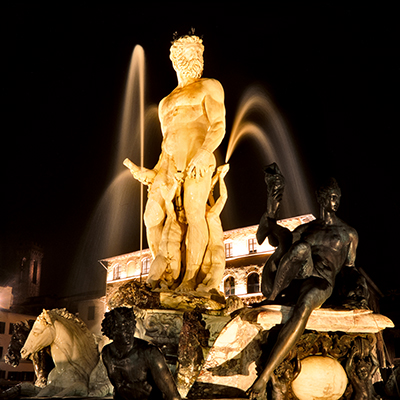
Fountain, National Gallery of Art

One of two matching fountains on either side of the great staircase to the South Entrance of the National Gallery of Art’s West Building.

Rock Collection (GSB)

The label on the back says, in part, R16 (Canada) / 5, but also says it was taken on the University of Texas campus on July 1, 2003.  Apparently I had some film to use up after a 2003 trip to Canada.  I usually think of GSB as meaning Graduate School of Business in the context of UT – Austin, but that doesn’t jive with my memory of which building had this rock collection outside it.

Comments not required.

Jets

Shot at Camp Mabry in Austin, Texas.  It seemed like a good opportunity for a “through the window” MF3D image.  I used these jets for shooting test rolls in Sputniks that were, to one extent or another, “fixed up” for sale via RMM.  I don’t recall whether this was from such a test roll or something I shot just for fun.  Might or might not even have been a Sputnik.

Comments not required.