Clear Buildings

I apologize for more architectural views, the second time in a row. These images have not gone around in a folio in over ten years, and I don’t think ever in this folio. Although some of you have seen them before, others might appreciate the views as something new. Also, sorry about the relatively poor sharpness, a limitation of the technology available to me at the time I made these images, almost twenty years ago now.

In the mid aughts I discovered the amazing photography of Michael Wesely, who was then making waves with his experiments in long-exposure photography.  Long exposure times measured not in minutes or even hours, but in years.  His book “Open Shutter” reviews images of architectural landmarks all over the world, where exposure times of up to two years were used to capture the visual abstraction and semi-transparency of architectural transformation.  I was much inspired by this, but I had to know: did Wesely do any of his work in 3D?  Because the images of his that I had seen were supremely suitable for stereoscopic capture, showing as they did incredible complexity, depth, and semi-transparency in structures that were being built or even being torn down.  I had a brief correspondence with Wesely soon after, and his answer was straightforward: he had not shot anything in 3D.

This gave me the green light, as it were.  I am motivated in no small part by applying stereo photography to subjects and or techniques that remain relatively unexplored.  However, in the case of Wesely’s long exposures, I was utterly out of my depth.  I did understand he had used cameras with lenses (i.e. not pinholes) that were heavily filtered.  But I had no way to know how heavy the filtering was, the effect of reciprocity failure in the photosensitive emulsions that he used, and/or how he compensated for those factors.  I knew from the start that at best I would be able to merely simulate his technique using digital photography: capturing images at a given location multiple times over the course of many months (or indeed years), but taking extreme care to position and align the cameras exactly the same way for each image capture, then combining the resulting captures digitally.

Alas, the cameras I was using had “only” 20 megapixels (Canon D60 DSLRs) sensors, with subsequent post-processing and ultimately printing onto film causing further losses in resolution and sharpness. Sorry about that; I know you’re used to much better sharpness in MF3d! I hope the interesting technique and subject matter is an adequate offset to the arguably poor image quality. These film prints were done at a service bureau with a so-called film writer. Nowadays I could probably get better results using my Pentacon MF camera to shoot the images onto film as displayed on a 5K computer screen, but it would take a lot of film and processing to iterate to satisfactory exposure and screen settings.

The biggest building I photographed using this technique of multiple exposures is Ruffin Hall, a new building for the Fine Arts program at UVA.  Over the course of 2007 to 2008 I staked out six different points around the building, from which I captured images.  Of those six, one was lost along the way due to a tractor trailer being placed right in front of my location, blocking the view of the site – but only after several months of construction (and image capture) had already commenced.  Of the remaining five viewpoints, three resulted in quite interesting views, but the one I’m showing in this round is by far the best, because this viewpoint was the closest to the action, obtained from the roof of the neighboring Fine Arts Library.
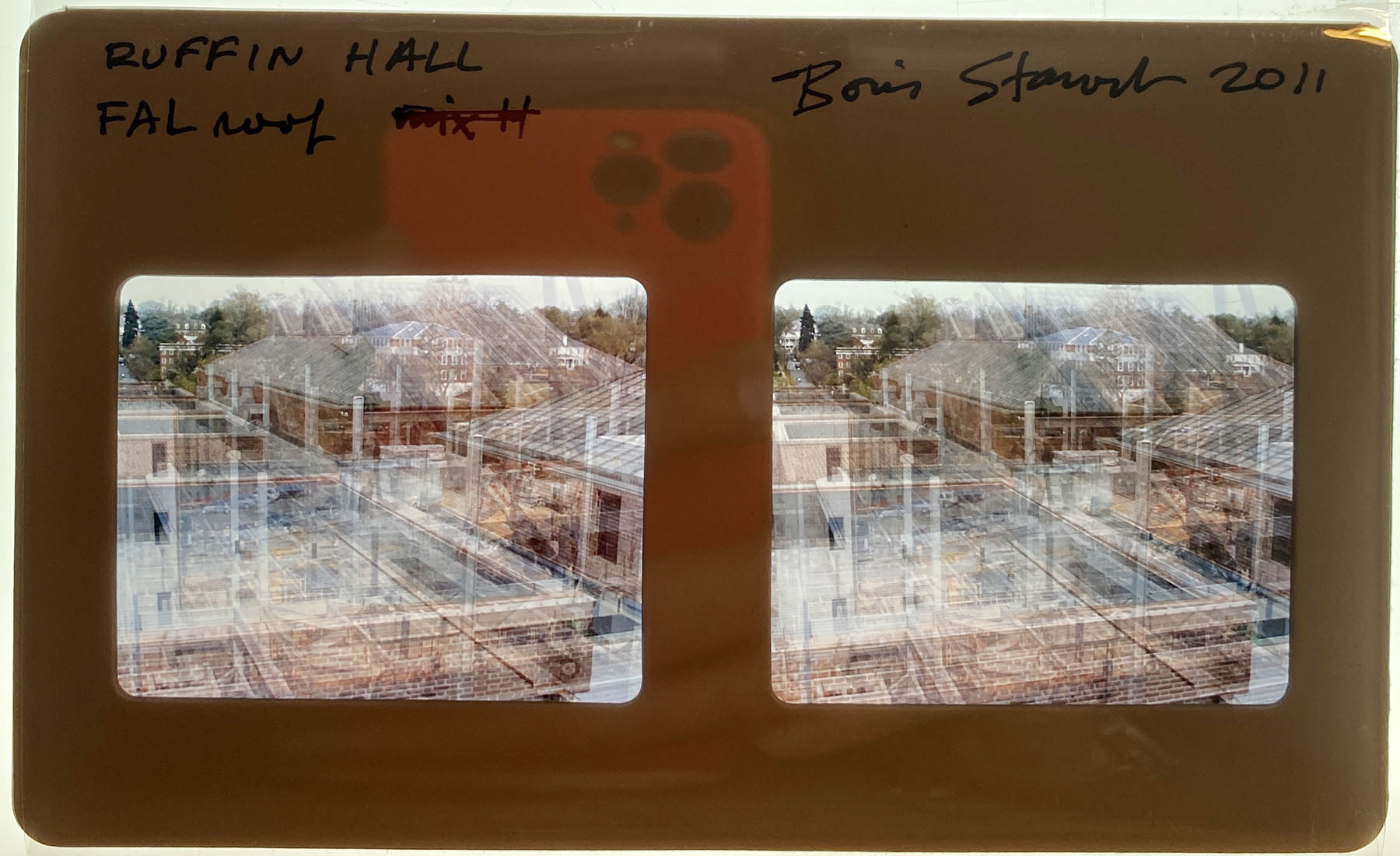
This image is a simple blend of six exposures taken over the course of some 18 months, with each exposure getting about equal representation in the final mix. This came close to the effect that Wesely had achieved with his ultra-long exposures. But I also discovered that the digital method opened up some creative opportunities that were closed off to Wesely and his wet-process emulsion-based long exposures. I could change the mix, change the transparency of the various images to achieve completely different results.
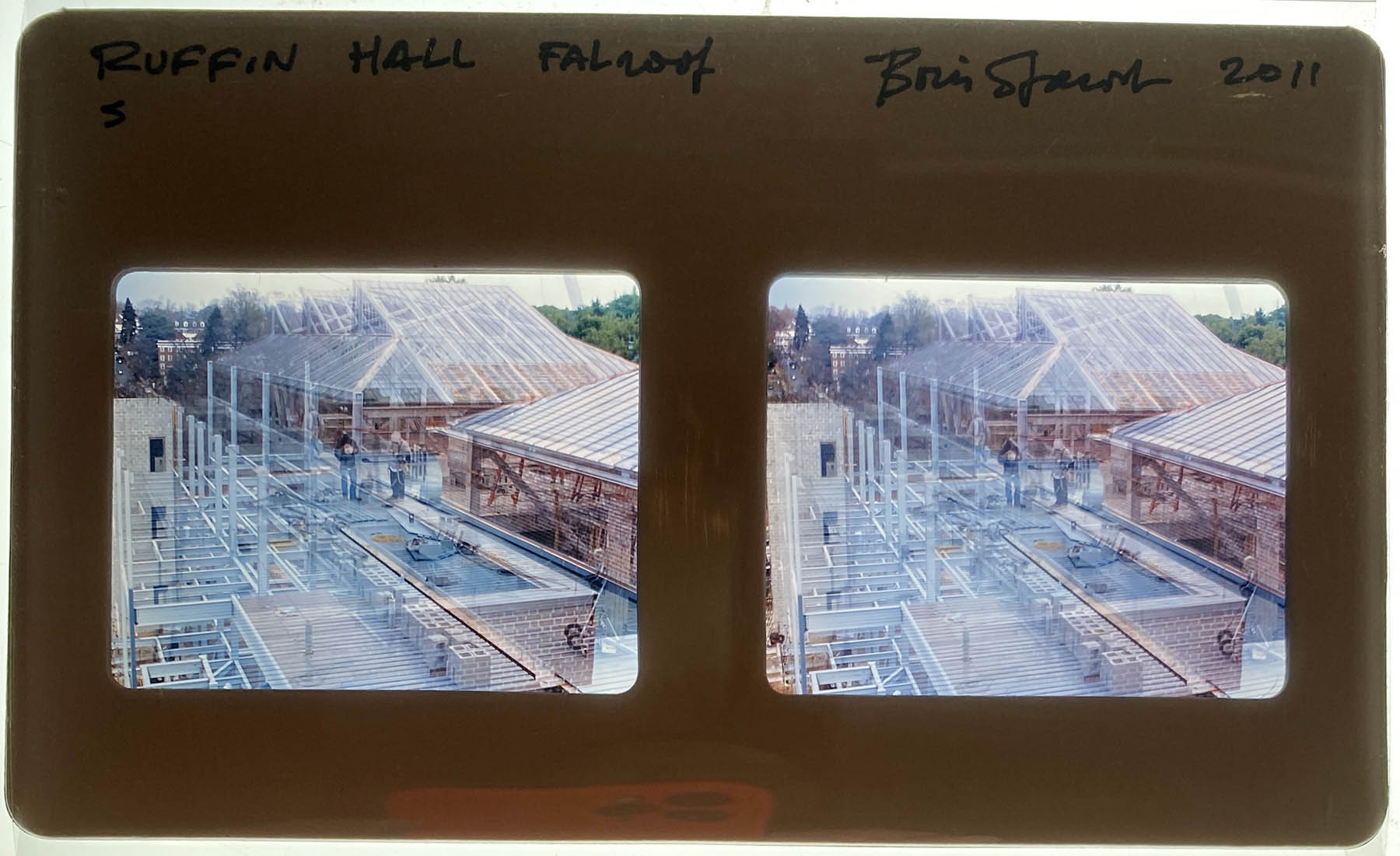
For example, in this second image of Ruffin Hall, I blended the images to show a progression of time, starting on the left side showing the earlier exposures, smoothly blending to the right side, where the building is shown finished. In-between, in the middle, is that delectable semi-transparent structural complexity that can be appreciated best only in 3D. By a pure lucky coincidence, some men in the middle of the image are conversing, but one pair of the men were photographed at a completely different time than the second pair of men. It looks almost like they are all conversing together in a time warp!

In the many views obtained of this and other buildings in those years, final composition was a matter of luck and some imagination.  Depending on the site and building, I might have had a chance to look at some plans or an architect’s model, and from these inputs, I had to decide on where to place and how to point the cameras.  Two more buildings came out quite well.
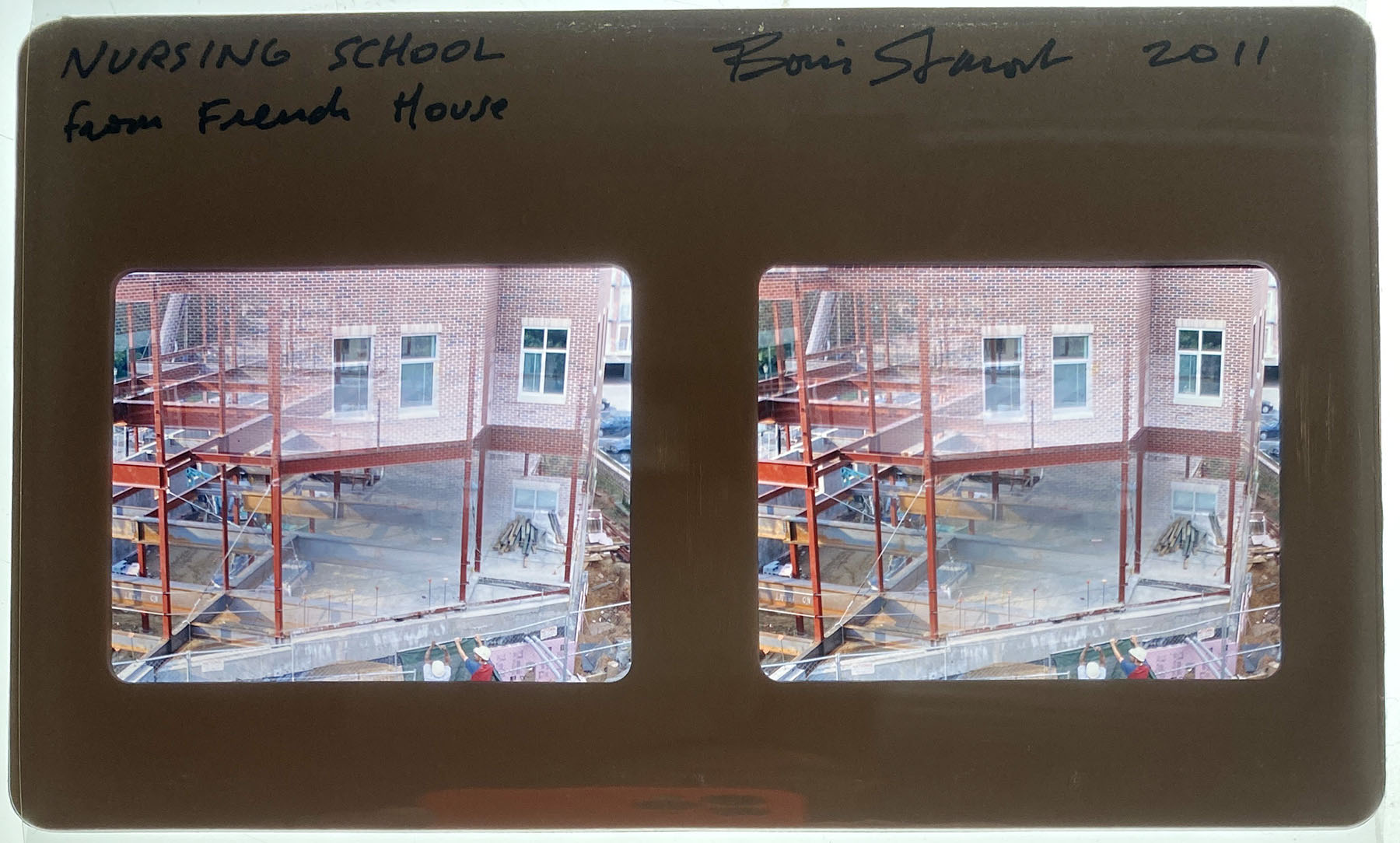
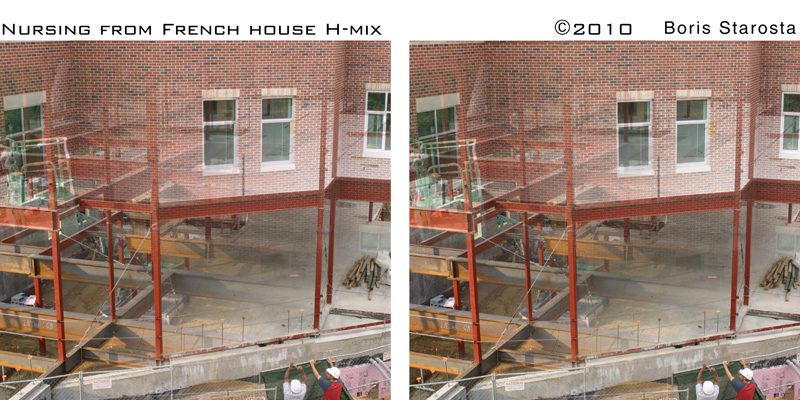
Like the Ruffin Hall image above, for a new Nursing School building I blended the various images so that a progression can be seen progressing diagonally from the earliest imagery in the lower left, to the upper right side, showing the finished exterior.
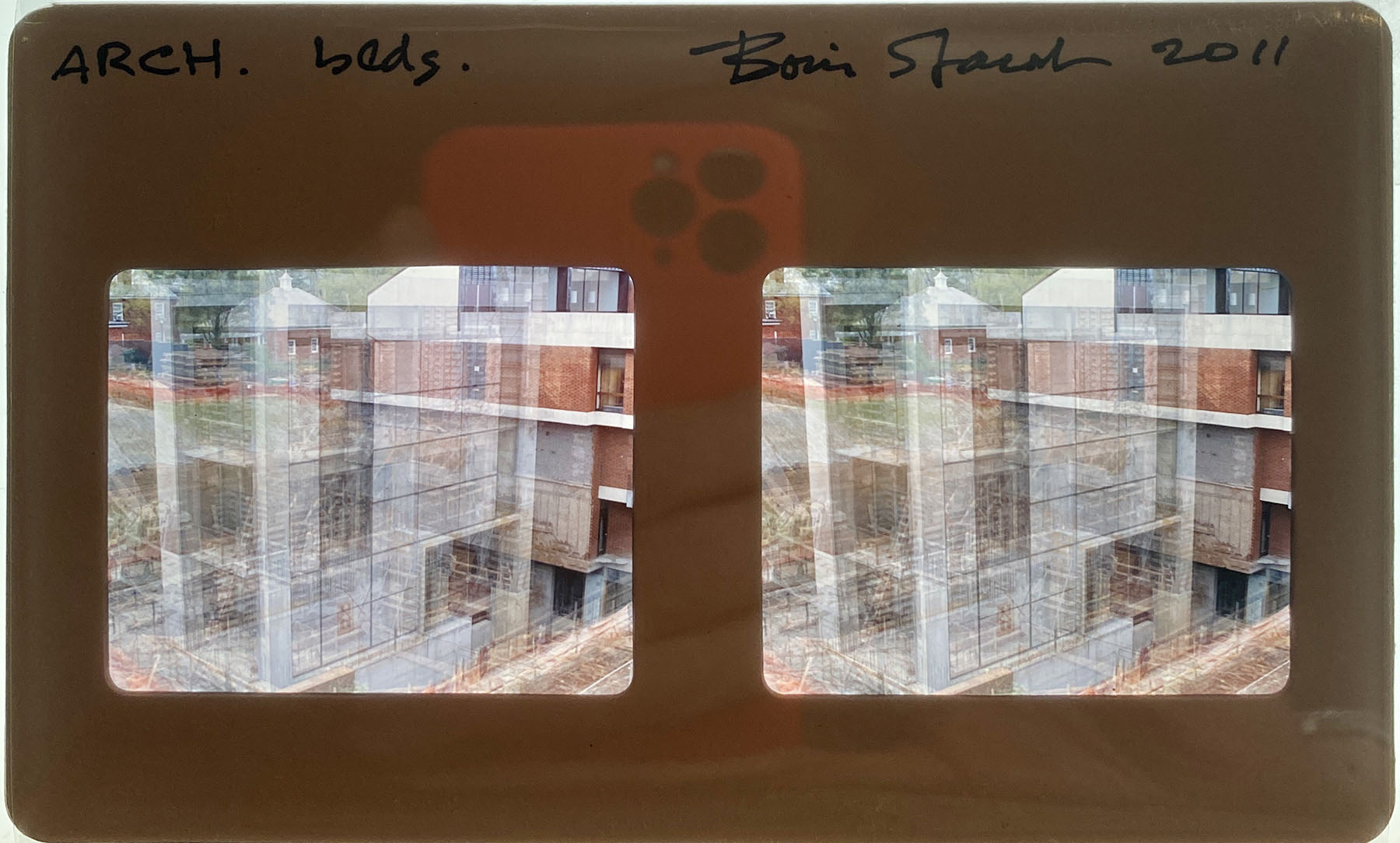
The ARCH bldg. is an addition to UVA’s School of Architecture, and you can see for this version I did a simple blend to make it look like a Wesely-style long exposure.
The Built Environment – Architecture and Machines

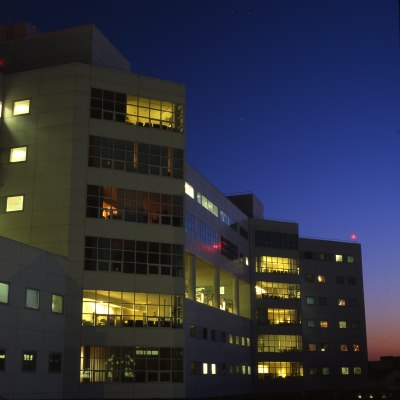
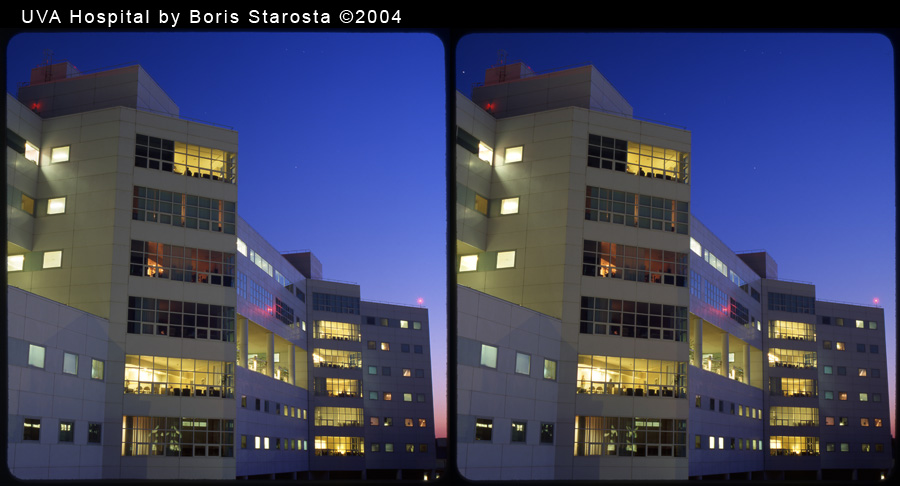
Ages ago, I shot this view of the (then) new UVA Hospital with a Hasselblad, maybe two of them on a bar – in any case this is a cha-cha to obtain the necessary stereobase, which was probably around a foot, judging from the parallax in the image. I imagine the exposure was around 30 seconds. Extra credit for the astronomers in the group that can identify the stars in the sky:

UVA Hospital, Charlottesville, VA

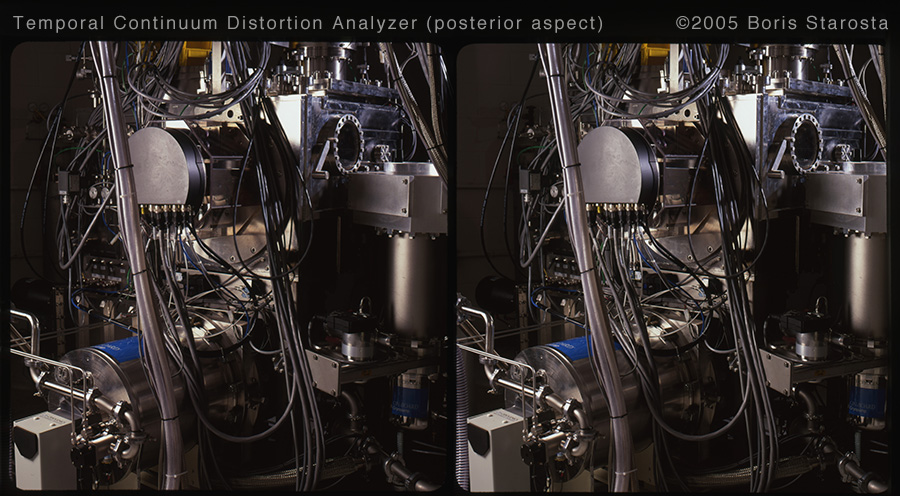
My “day job” is technical illustration. My clients are engineers at the University of Virginia, mostly. One day I went to visit a lab, and discovered this gigantic machine. Impossibly complex in its construction, for all I knew it could have been a time machine. So I started calling it the “time machine,” whenever I mentioned to my engineer client, and that I’d like to come in some day to photograph it. The title of the image that I finally made says about the same thing. For real, this is a Directed Vapor Deposition machine. A big electron gun hits one material, vaporizes it, and the vapors are deposited onto another material. Believe it or not, it is not a custom made machine. You buy these things retail. Cost? about $1M:

Temporal Continuum Distortion Analyzer (Posterior Aspect)

In or around 2012, I had the opportunity to photograph inside a retired coal-fired power plant not far from where I live. This plant, in Bremo Bluff, VA, was the first “automatic” coal fired power plant built in USA. “Automatic” meant in those days that most of the valves, flaps, conveyor belts, and other machinery was centrally controlled. Which means, there was a central control room, where through the use of electrical switches, one could remotely actuate any of the hundreds of valves in the plant – as these were electrically actuated. I’m sure there was a measure of fear or distrust in the system early on, as plant operators were instead used to shouting control commands at a team of plant workers, on whom one could surely better rely to get the job done than the new-fangled electric motors.

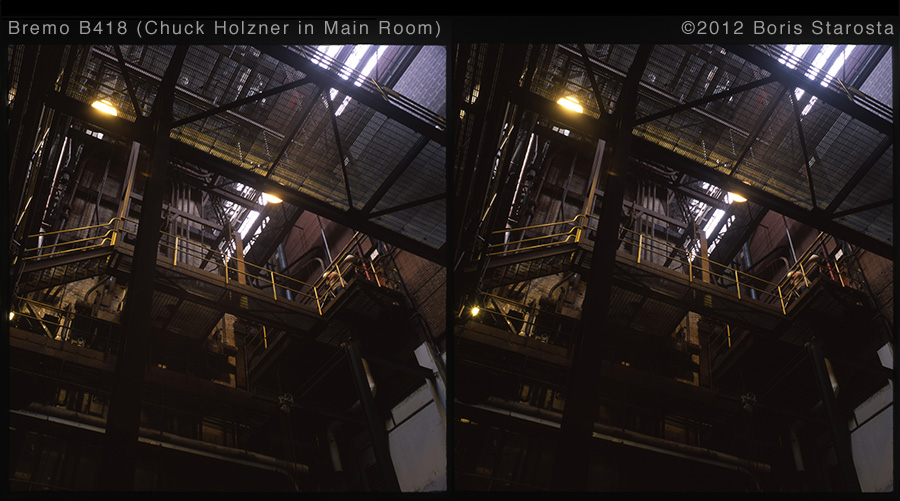
I worked on three separate days in the plant to make photographs, using with great pleasure John Thurston’s custom TL-120-55 for the wide angle views. I am forever indebted to John for his generous loan of the camera to me that year. In this view we have my old friend Chuck Holzner up there on another level (see the white hard-hat?) taking some of his own pictures. Along the left side of the view, rising up through the various levels, is one of the four burners in the plant. These are 100 foot tall furnaces (not counting the smokestack outside the building!), that included Ash removal apparatus at the very bottom, a furnace chamber 1/3 of the way up including hundreds of pipes for heat exchange (i.e. for boiling water, making steam), and at the top a variety of filters to capture particulates in the exhaust. I’ll guess this was a three seconds exposure:

Bremo B 418 Main Room

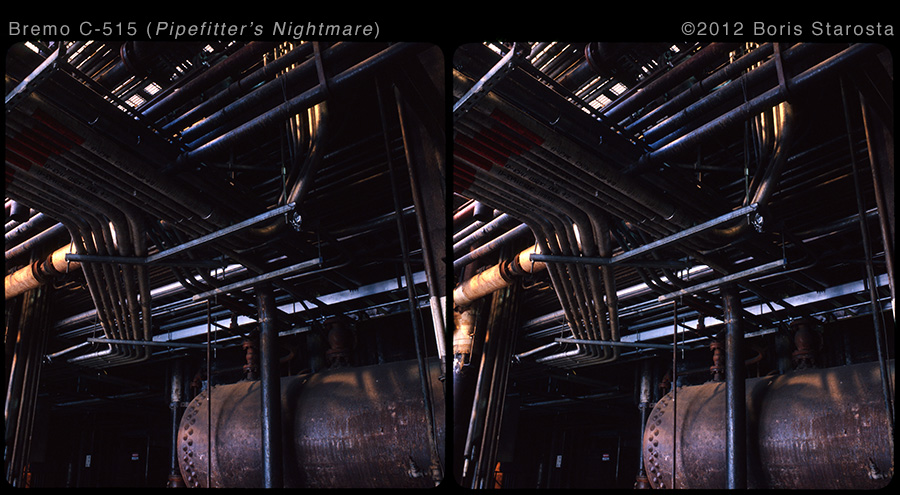
Elsewhere in the plant, I captured this view of just a tiny fraction of the pipes and plumbing that, along with grated floors and vast spaces, characterized the place. Probably a thirty seconds exposure in this dark spot:

Bremo C 515 “Pipefitter’s Nightmare”

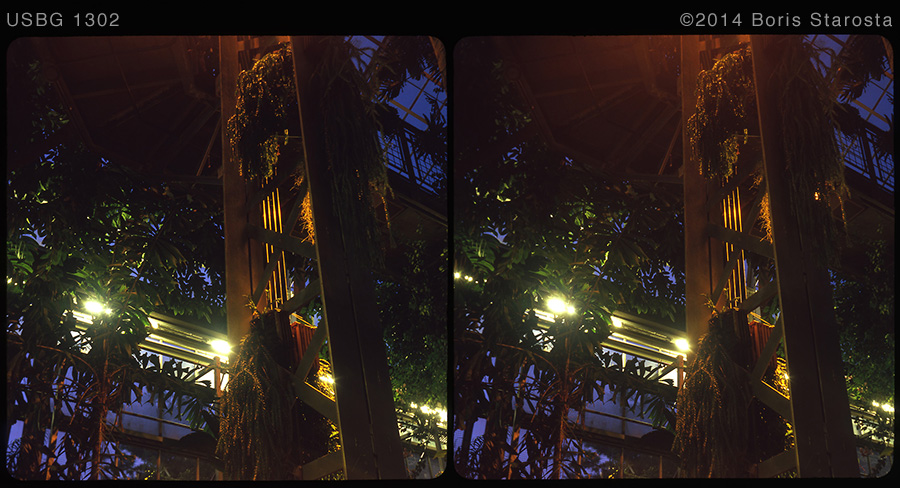
I’ll close with an image obtained in or around 2014 at the United States Botanical Garden in Washington, DC, where I fell in love with the “Jungle” greenhouse that is central to the place. In this three-stories tall greenhouse, one can commune with a variety of lush tropical plants, even in the deep of winter, and witness the slow motion battle between the built environment and the imprisoned flora. This picture was taken with a Sputnik, a good bit after sunset – I like the interplay of just a little natural light in the background, with artificial lights in the foreground. I imagine about a ten or twenty second exposure.

USBG-1302

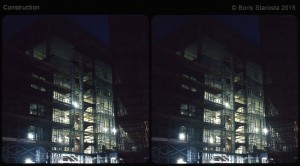
Construction

For the past year or so there’s been a hotel going up across the street from my studio.  Though I swore some years ago that I was “done” with “clear buildings,” the proximity and thus convenience of this building stimulated me to make one last one.  It’s the reason I bought a Sigma (DP-1 Merrill) camera: this last Clear Building will be shot with some decent resolution, so that I can make truly large prints.

construction_MFT-folio28A

That work has been digital and is ongoing.  But on a recent early morning, I found the building looking quite attractive, complex and mysterious.  I shot it with a Sputnik, shooting cha-cha to obtain a larger baseline – maybe 12 inches – to give it more depth and interest.  I did not record exposures but I think I shot thirty seconds at f-11 onto Kodak E-200.


Clear Building (Nurse F 12 mixH)


This is a digital “dupe” made by Gammatech from a file I sent them. The file for each of these images was about 2500 x 2000 pixels, about 1200 pixels per inch. I had them “print” eight stereo pairs like this onto an 8×10 inch transparency. They offered two resolutions for this, “8k” and “16k.” I asked them to print my file at “16k” because my file had a resolution around 12k. I might try doing it onto 70mm film next time – the cost is about the same either way. This imagery was obtained and processed digitally. Cameras: twin rig Canon D60 (6MP DSLR) with 28mm lenses, stereobase for this view about 9 inches.

Using a multiple exposure technique, buildings are rendered magically translucent, revealing the structure beneath the facade, and the foundation beneath the structure. Images were obtained over a period spanning 12 to 18 months, each time from a platform carefully repositioned, so that the camera(s) would be in exactly the same spot, matching position, direction and orientation in six axes. From about 2007 to 2010, I recorded the construction of a half-dozen buildings like this in and around Charlottesville. With its requirement for extreme accuracy, digital post-processing was almost as much work as the photography itself!

Williamsburg Bridge

Fuji RAP, f11 (?), 1 sec. exposure in available light, using Sputnik on loan from Chuck Holzner. Camera stabilized on walkway/surface of bridge.   Slide in folio is original film.

Cycling over the Williamsburg bridge to visit someplace in Brooklyn, I took interest in the elaborate riveted steel trusswork along the way.  It was very cold, and I had no tripod.  I placed the camera on ground and tried to stabilize it with a pocket knife acting as a shim to get the angle.  Aim and thus composition was guesswork.  I would have wanted a longer exposure/smaller aperture, but the rig was shaky, so I dared not.  Luckily, it was wintertime, so the traffic was light, and I was not reported to the TSA or other anti-terrorist authorities as a person of suspicion – it’s sad what one has to be afraid of these days.

UVA Hospital

scan001053Shot in natural evening light using twin Hasselblads with 75mm lenses.

I had set up the twin rig Hassys but one of them was acting funny, making a nasty noise advancing the film (they have electric/motor drive film advance). Just to be safe, between exposures I shifted the tripod over 9-12 inches each time. I figured if the film advance was screwed up (it was) I’d have some side-steps on at least the one roll. And that’s how I “succeeded” in my photography that night. The careful observer will be able to make out the Orion Nebula in this shot, as well as read the time of day in a distant wall clock!

12″ (?) interaxial original slide shot in 2004.   f/11? five to ten seconds exposure, if I remember correctly.

Play The Building


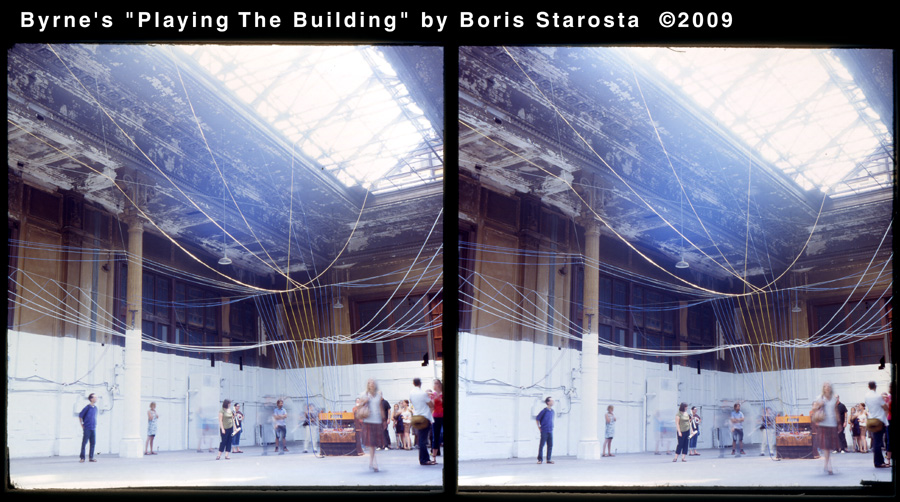
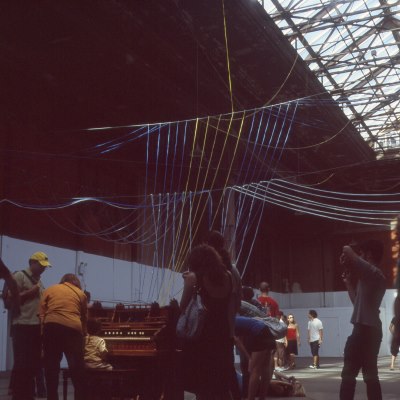
David Byrne rigged up this industrial space in NYC with numerous actuators – hammers, motors and similar vibration inducing devices – attached to columns, radiators, roof trusses, etc. Visitors to the installation can sit down at the old organ keyboard, where from they “play the building”. The music/sounds thus created, in combination with the space are very mesmerizing. I was there on two occasions. Once nearly empty (I got to play!), the second time with Spud, very crowded. The effect was different each time, interesting both times.

Above: Fuji RXP, f11 (?), 1-2 sec. exposure in available light, using Sputnik, 80mm lenses.scan001055
This is the original slide shot in summer of 2008.

The organ was modified to send signals via electric or pneumatic lines to the various actuators. The music was essentially percussive: lots of clinks and clanks. Only the electric motors near the ceiling, in the trusswork under the skylight, produced “tone” – a dark, rumbling, droning tone.

Right: Fuji RXP, f11 (?), 1/8 sec.  Exposure in available light, using Sputnik, 80mm lenses. This is the original slide.