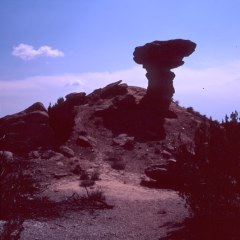
Coronado Historic Site, New Mexico 2025

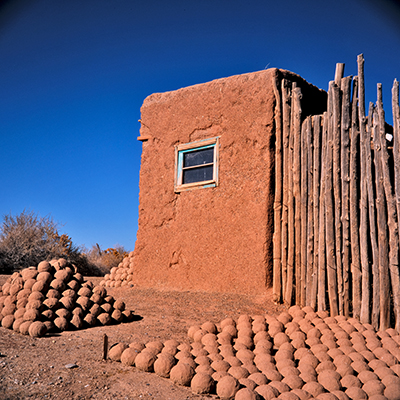
My wife and I visited her sister in Albuquerque last year. We had always been curious to see that part of the country. We liked it, but still love the fresh green trees of the Pacific Northwest more. After visiting, we do understand some of it’s magnetizing aspects. Native American art and heritage, unique architecture, and it’s quirky and fascinating history. All in all, I was not totally happy with most of the shots I took there, and I only shot about 2 rolls while I was visiting. So, needless to say, I didn’t have a lot of shots to share. This is a shot of a maintenance building that was built using the same methods as what the original buildings would have been built with back in 600AD. Except for maybe the added window frame of course. The balls you see there are called ‘armas de la tierra’ or ‘weapons of the earth’. This was a Tiwa people’s ancient adobe construction technique. They would use the balls to build walls while they were pliable, thus becoming hardened and sturdy after being dried in the sun.

Coronado is located near Albuquerque and the mighty Rio Grande River, and has been around since at least 1000BC.  Everything was fine and dandy until 1540 when a group of European colonists visited and fought with the populace in trying to find gold and silver in the region. None was found, and the expedition was ended in 1542. It was colonized from 1542 onward. Conflict and disease led to a downfall after the Pueblo Revolt of 1680 and the town was abandoned. It was later designated as New Mexico’s first State Monument site in 1535. Not much is left of the site, hence the picture of the work shed instead of the ruins left behind of the village. I found the work shed to be more interesting to photograph. Shot with my Sputnik, 100th sec., f.22, Bright sun! Provia 100f Fujifilm.
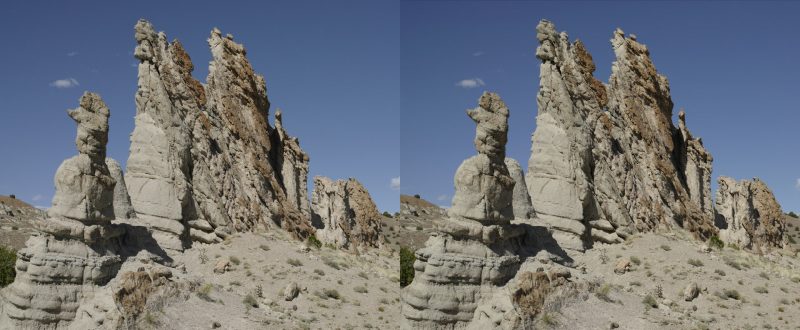
Dragon Spine Plaza Blanca New Mexico

DP2M0107_small2

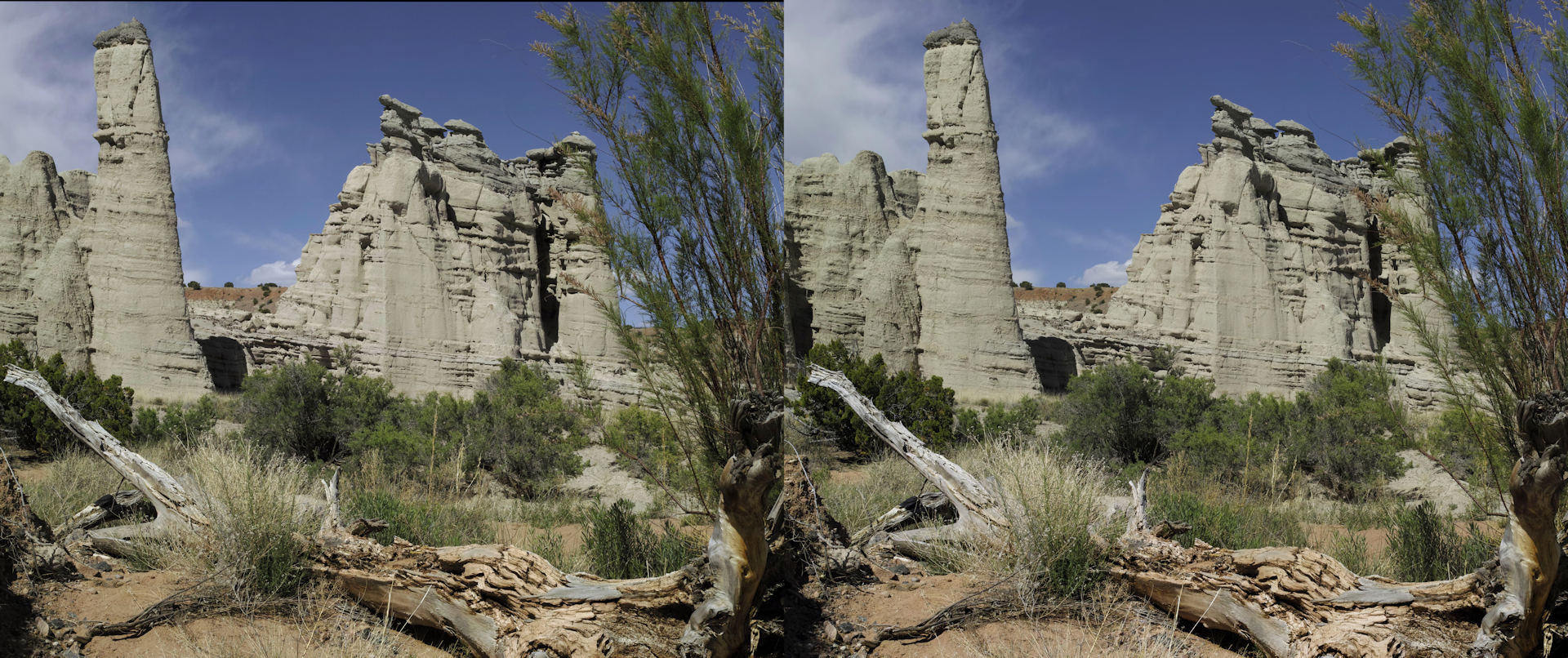
Plaza Blanca is about one hour north of Santa Fe New Mexico by car, the last couple of miles is a dirt road. Spectacular rock formations can be found only a few hundred yards from the parking lot. I’d just started walking again after all the foot surgeries. This was taken with a paired Merrill Dp2 rig, on a sliding bar with about 8 inch stereo base. Then the image was transferred to Provia 100F by photographing a 4K screen.  (I describe the process in more detail in A28 folio notes). The developer was nearly exhausted and resulted in thick image with excessive contrast. I plan to send my film to Colorado lab in the future. There are lots of lovely digital images taken with this Foveon sensor camera (thanks to Boris Starosta for turning me on to the Merrill, he uses Merrills in his clear building series). The Foveon sensor records all RGB at each site in a ‘stack’ of sensors, so each color plane has all the full resolution, without interpolation since there is no Bayer filter.  I plan to upgrade to a 10 bit calibrated 4K screen, and eventually to an 8K screen for future digital to film experiments. I’ll also do some head-to-head tests going back to photograph the original subjects with digital and film (TL-120 and paired Mamiya 220 85 and 55 mm). I’m quite please with the Merrill sensor and lens, have the DP3 now too. Merrills are like using slower film cameras (usually want ASA at 100, tripod or good light for routine use), the slowness comes from the ‘thickness’ of the sensor, as light has to make it into the depths of the chip to provide the color information. But this lens is amazingly sharp.

The Pillars, Plaza Blanca New Mexico

The Pillars, Plaza Blanca

The Pillars, Plaza Blanca

Plaza Blanca is about one hour north of Santa Fe New Mexico by car, the last couple of miles is a dirt road. Spectacular rock formations can be found only a few hundred yards from the parking lot. The process used was the same as described for my image “Dragon Spine, Plaza Blanca”. This is one of the most beautiful sites in New Mexico for these odd eroded columns. These are a bit like the Tent Rocks (those are found an hour south of Santa Fe)…featuring a capstone protecting a column of softer material. Once the capstone is gone, the column will erode much faster. The area has changed in 10 years due to this process. If we ever have an NSA meeting in Santa Fe, this is one place to check out.

Dragon and Rider, Plaza Blanca

Dragon and Rider, Plaza Blanca

Dragon and Rider, Plaza Blanca

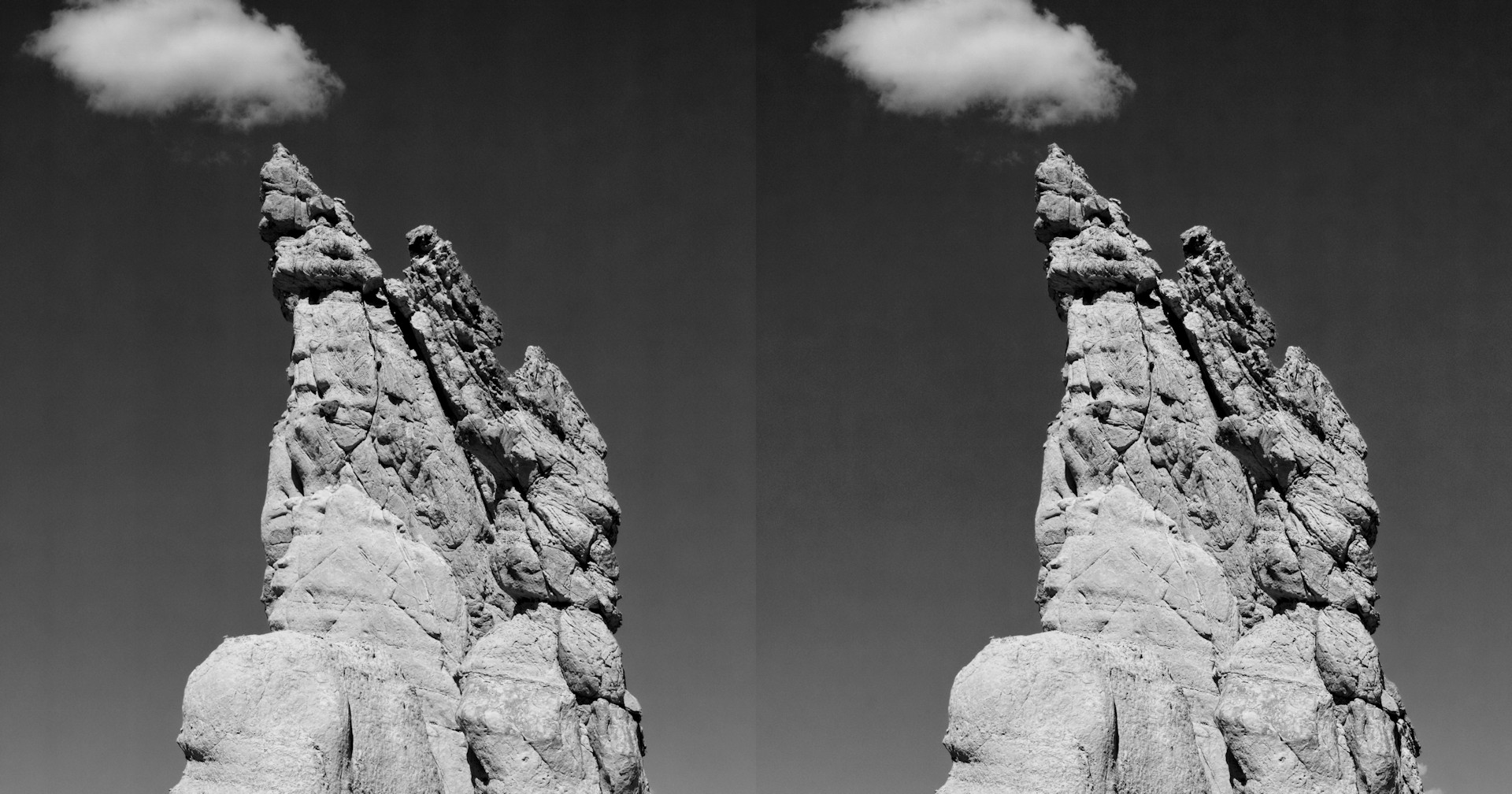
Alternate view of the Dragon Spine formation at Plaza Blanca, about one hour north of Santa Fe New Mexico by car, the last couple of miles is a dirt road. Process used is the same as for the Dragon Spine image (described in more detail there). The process for digital to film I described in my notes for A28 folio entries. This is the red channel only, spreading the histogram to result in maximum range from black to white (some of the streaks are from the JPG compression when I uploaded this image). The 16 bit Sigma Merrill image (which as 12 bits of useful range, padded to 16 bits) was processed in Corel PSP. This seems to introduce some aliasing in dark quarter-tones, next time I’ll use a 16 bit work flow. Most of the PSP workflow is 16 bit, but histogram manipulation seems to sometimes result in gaps in the color scale. This can be seen in the patterns in the sky, which was pushed down to make it dark. I could also try a red filter, but the red layer of the Merrill sensor is pretty good at that color separation. Perhaps a polarizer! Someone showed a film rig in 2012 (the MF SIG) at my first NSA and it had some square gradient filters, I could likely go that route (I think it was Bob Venezia). Close one eye and you could imagine this is a rider and a dragon, with a puff of smoke. In 3D that illusion is less convincing. Still, the figure to the lower right looks like and earnest fellow with a big nose and his muscular arms at his sides.

Inaugural Offerings

Geoffrey Waldo is our newest member in 2013. As you may be able to discern from his images, New Mexico is home.

I’ll go out on a limb and suggest these images were created with a TL120-1.

–John Thurston