Scrutinizing Sharpness (Ian Andvaag A33)

For this loop, I wanted to get some feedback on sharpness. I’ve been working through some of Mike Davis’ spreadsheets and trying to determine if I’m leaving a meaningful amount of sharpness on the table by using a TL-120 or Sputnik. As I understand it, Mike’s contention is that it is not possible to get critically sharp slides with appreciable depth using standard 60-65 mm stereo base and normal FL lenses. I’m rather surprised by this contention after having seen many fantastic slides taken with TL-120s and Sputniks, but I know it’s easy for one’s eyes to be fooled, and I would guess that 95% sharpness looks close to 100% sharpness. I will say that I was particularly struck by David Lee’s Yosemite Fall slide that was included by John Thurston this loop, which seems impossibly sharp, and was not taken with a standard stereo base. I believe the proper way to investigate sharpness would be to shoot some scenes with resolution test charts at various distances and then to side by side A/B comparisons with the resulting slides in a viewer. I wish I could ask Don for advice, I know he occasionally did tests like this 🙁


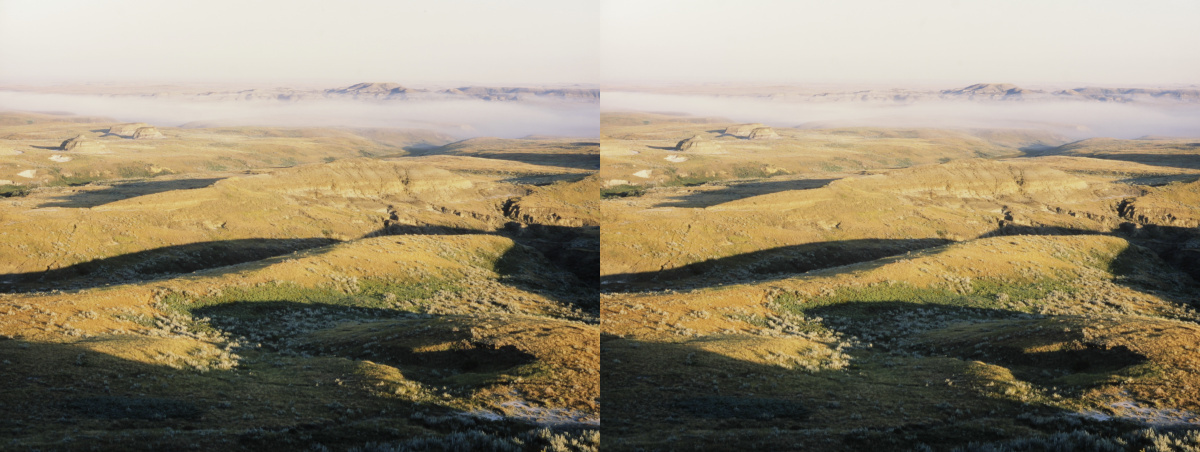
With all this in mind, I picked out several slides which I personally believe to be quite sharp, and I would appreciate any feedback from others about any perceived lack of sharpness. Cloud Inversion should probably be considered as the “base case”. I believe the nears were around 50′ and I focused around that point, shooting at f/16 I believe. I believe this should secure more sharpness than the eye is capable of detecting in a standard viewer. I don’t really know anything about a cloud inversion, maybe this should better be called thick fog that settled into the valley.  Anyway, it was rather unexpected and interesting to see when I woke up to photograph at sunrise. There is a bit of retinal rivalry in the clouds and shadows as this is a chacha with a tripod and it takes some time to set up the tripod and adjust the framing. Apparently quite a few dinosaur fossils have been found in these badlands.
Cloud Inversion


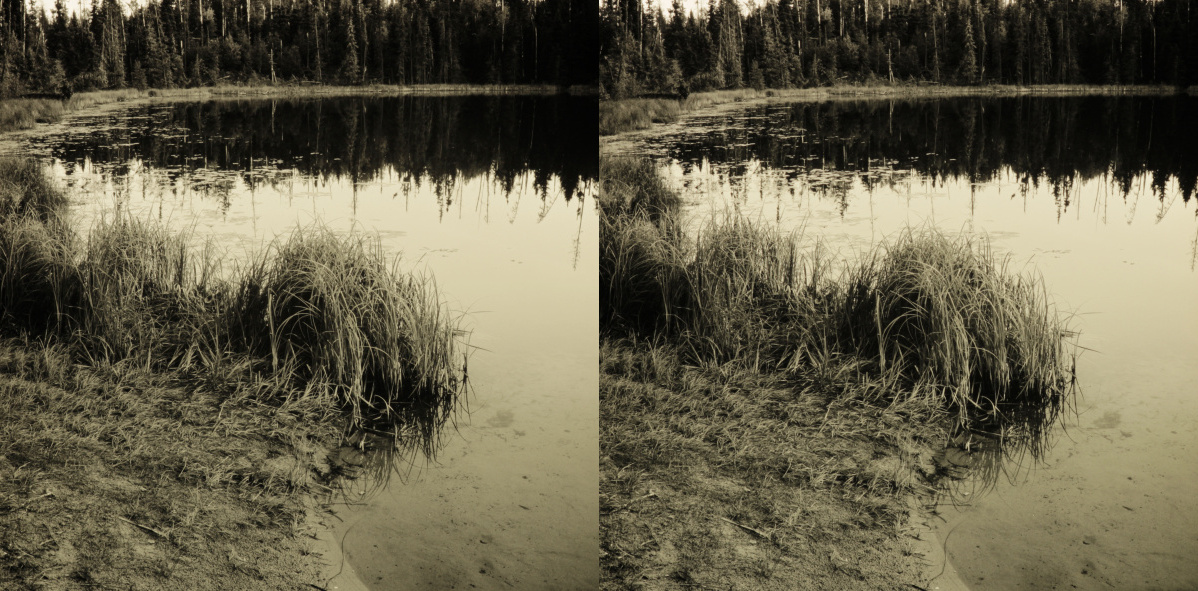
I perceive Gem Lake Reflection to have a high degree of sharpness, however I don’t think it is objectively sharper than any of my other standard TL-120 slides. I believe the perceived sharpness is largely due to the adjacency effects caused by the high acutance first developer, along with the fairly visible grain.
Gem Lake Reflection


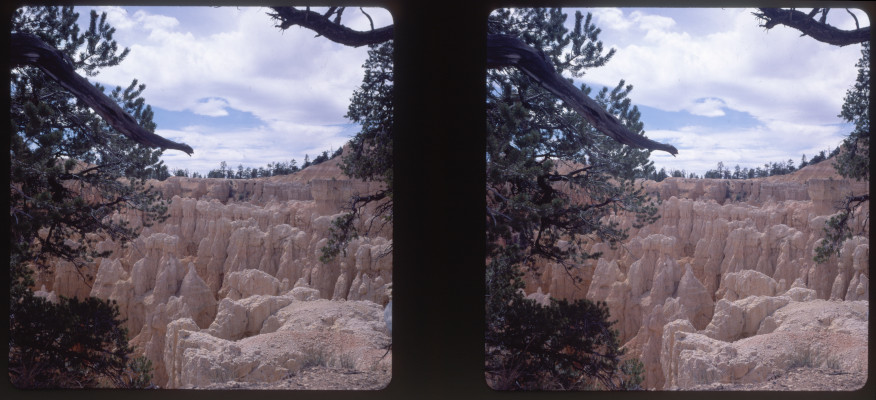
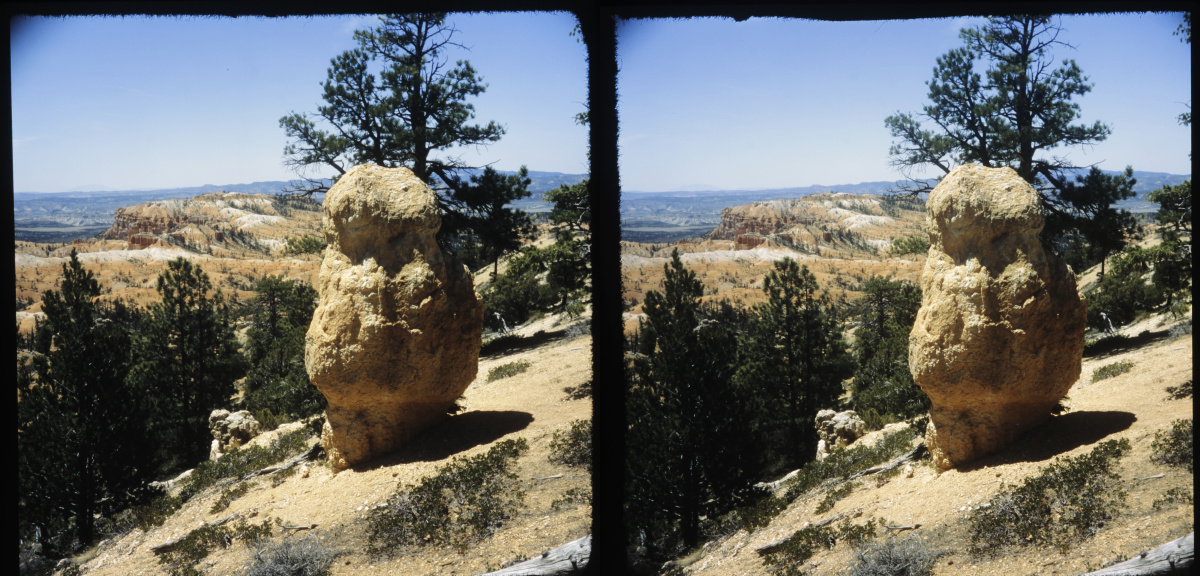
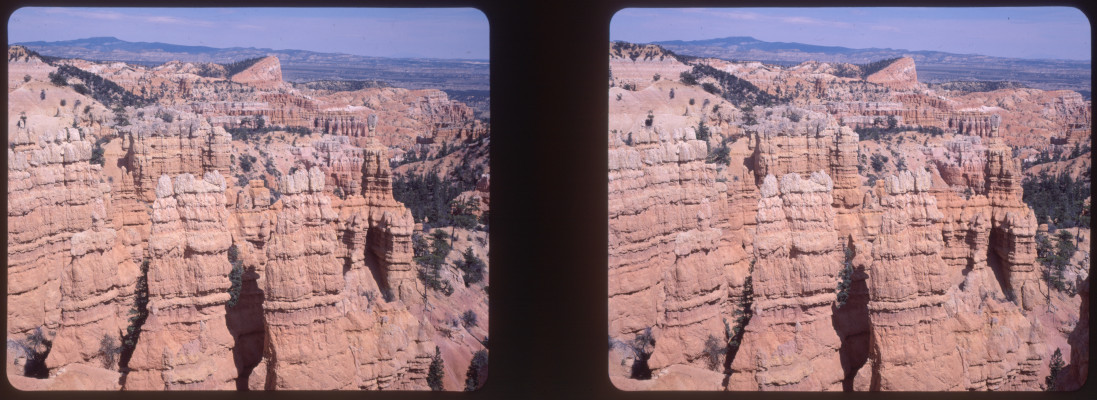
Bryce Hoodoo, yes this is a Sputnik shot, and there probably is some falloff in sharpness towards the corners, but I’m not sure I can detect it! Maybe the pine needles at the far right are a bit soft. This is a pretty “easy” shot to secure sharpness as the deviation is quite low, (the nears are rather far away) but I would be surprised if I changed the aperture off the default f/22 hyperfocal setting. I do think the rock and ground appear sharper than the objects in the far distance, but I’m suspecting that this is more due to the haze and lack of high spatial frequency information in the distance rather than the Sputnik having overly relaxed hyperfocal markings, although it could be both!
Bryce Hoodoo


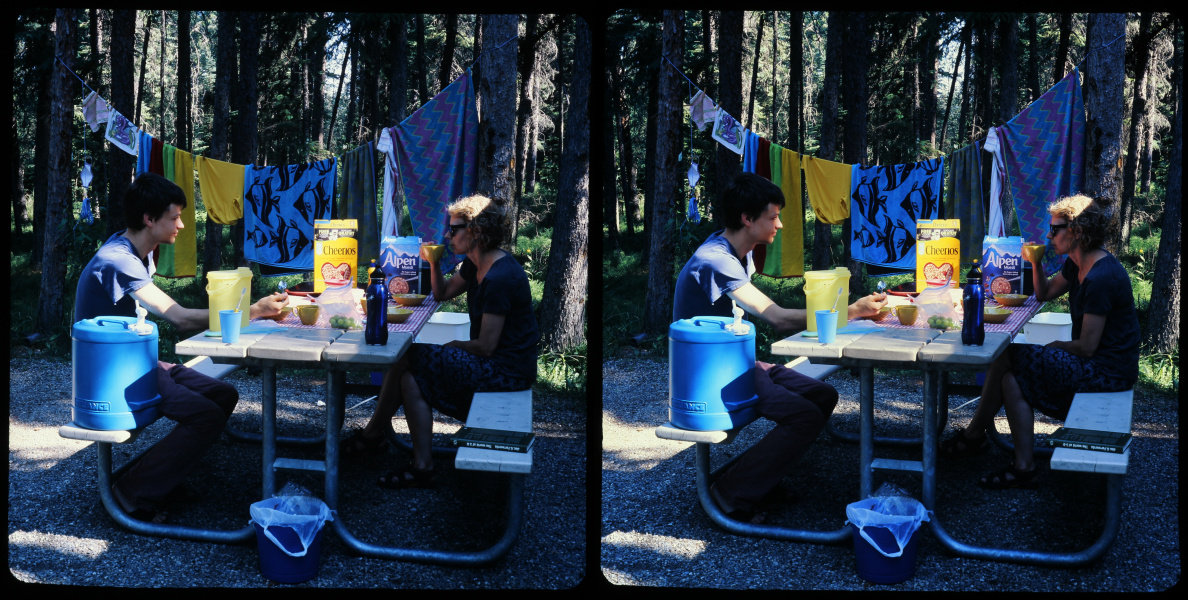
Camping Breakfast was shot at f/22 using the standard hyperfocal markings on the TL-120 and I used the entire range (the near distance was 3 meters). I might be able to detect the smallest lack of sharpness in the specular highlight on the blue water bottle, but I’m not sure. I think the exposure was 1/8 of a second, so the people are probably not perfectly sharp. Yes it was posed!
Camping Breakfast


In my opinion, Cloud Inversion does seem ever so slightly sharper than the others, but I’m not entirely convinced it is because of the more conservative DOF tolerance, but rather that the size of the plants at this distance provides a fairly high frequency subject and the low angle of the sun provides fairly high contrast, while non-hyper shots typically have inherently less high frequency detail.


So what do you think? Do you use the standard hyperfocal settings on your lenses? Or do you stop down one extra stop? Or some other technique? Ok, enough nerd talk. Sorry to ruin a perfectly good post with all this talk of sharpness! I certainly don’t think it’s the most important aspect of a successful MF3D shot, but it is fun to discuss.
4 From Bob Venezia

4 From Bob Venezia

4 From Bob Venezia

Timing was very unfortunate this year. I blame the Coronavirus. I received 2 folios within days of my state being identified as one of the world’s hotspots. The problem was compounded when several of my coworkers were ordered home because of potential exposures to the virus. For a while I was doing the work of 5 people. Even though by now there are 4 of us doing the work of 5, I’ve still been working long hours and not getting enough rest.

Sorry to have held onto the folio for so long. I’ll try to add some context to the photos in the coming days.

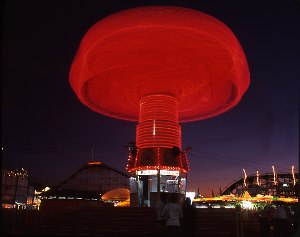
Skydiver is among my all-time favorite carnival ride shots. It’s the only time I captured the intermittent movement of this ride while it was loading. (My other captures of the ride show a more boring seamless disk when the ride was in full motion.

Photographers Playground is a slight hyperstereo shot at Bryce Canyon. At the time I was cursing these people who were messing up my nature shot. But clearly I ‘m an idiot, as you can see that they make the shot. Shot with Hasselblads at about 18 inches separation.

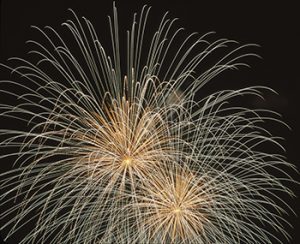
Fireworks (Sorry, I’ve already sent off the folio and don’t remember the exact title) is another of my hyper shots with forty feet separation.

And Edison Advances is shot with twin Hasselblads in a macrobox with a beamsplitter.

Grand-Staircase Escalante

In April 2018 I went on a road trip to Utah with a few friends. We stayed in the campground in the town of Escalante and went on day hikes to Lower Calf Creek Falls, Escalante River and the Dry Fork Slot Canyons.

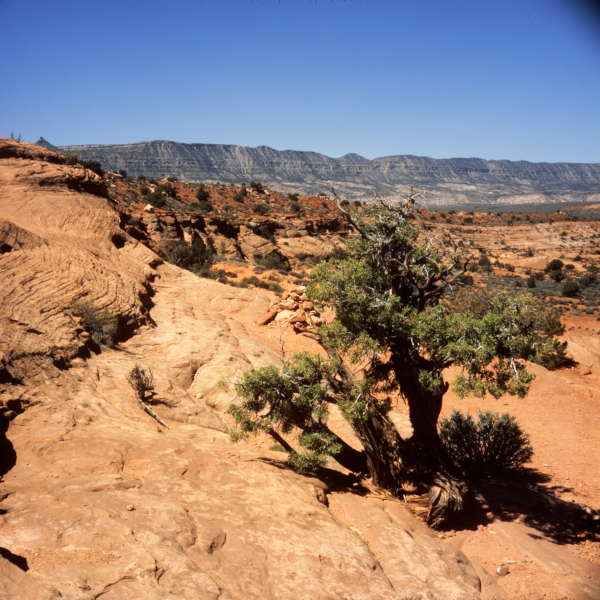
Grand Staircase-Escalante – RDP III – Sputnik (Location)

The Grand Staircase-Escalante National Monument was (until recently) the largest National Monument in the contiguous US and comprises enumerable canyons, including some famous ones such as Bryce and Zion. On our first full day, we decided to visit the slot canyons nearby after speaking with the campground owner. I took this slide at the top of the Dry Fork trail which leads down to the slot canyons.

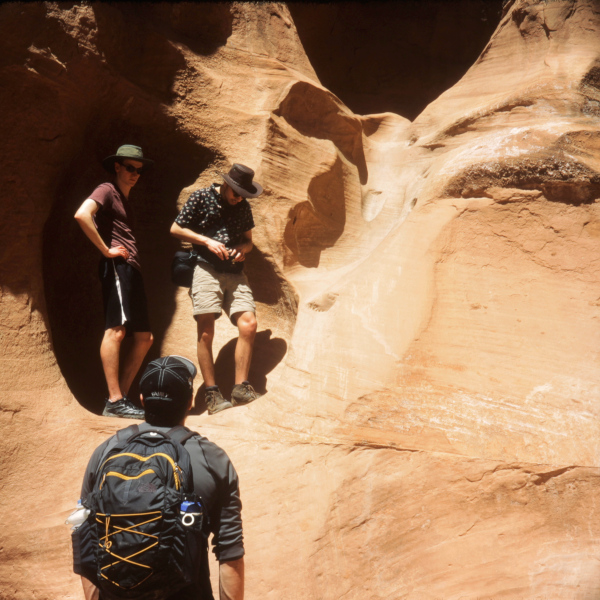
Slot Canyons – RDP III – Sputnik (Location)

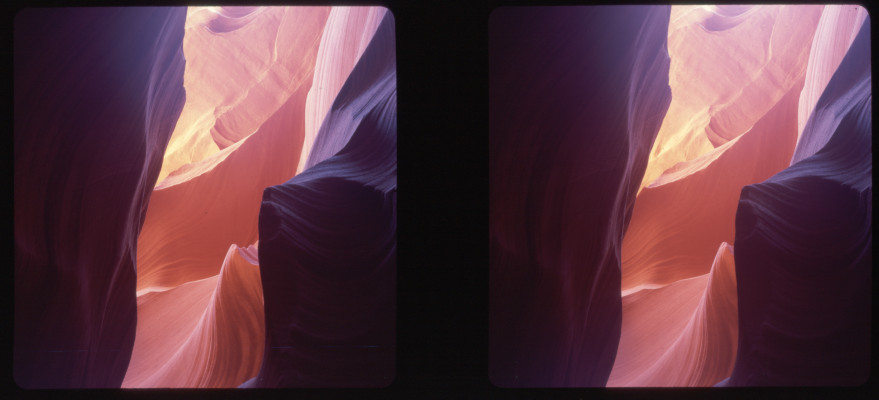
This was taken at the mouth of Peek-a-boo slot canyon. It’s quite high up and it was a bit tricky to get up with my tripod and Sputnik. There wasn’t too much stereo photography that could be done within the slot canyons since the narrow corridor would cause window violations. It’s a really neat place, and I recommend going if you get the chance. The road to get there is like a washboard though, so don’t take a nice new vehicle. Peek-a-boo was the shortest and easiest of the slot canyons here. We also went down Spooky canyon, which was extremely narrow at several points — I couldn’t get through with the backpack. It was also very dark in some places and the sky couldn’t be seen at all. Apparently the third canyon, Brimstone, is even narrower and has pools of water you have to wade through! We ran out of time to attempt it.

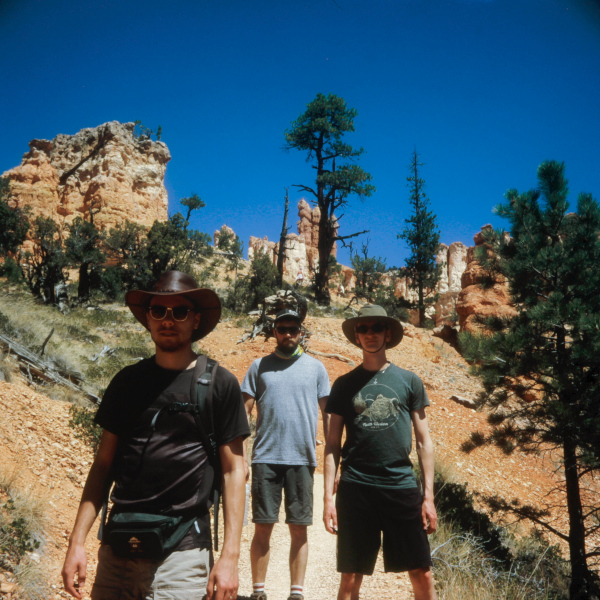
Heroic Hikers – RVP 100 – Sputnik (Location)

On our drive back home, we stopped at Bryce canyon and hiked the Fairyland trail. It’s a very beautiful hike. These are my hikineg friends: Gabe, Derek, and Elliot.

Sinking Ship – RVP 100 – Sputnik (Location)

All along the hike, I was wishing I had some sort of twin camera rig, or a bit more time to do some cha-chas. It’s sometimes hard to balance photography with other activities, like hiking with others. I do a lot of walking, so I’m able to take photos and keep up quite well, but it still takes a fair bit of time to stop, set up and level my tripod, meter the scene and take the shot. When we arrived back at our vehicle at Fairyland point, I decided I really ought to take a hyper — cha-cha style. Unfortunately I didn’t have a lens cap or Mike Davis’ spreadsheet, but I found a railing to slide my camera on and I covered one lens with my hand. My apologies for the slightly excessive on-film deviation and corresponding window violation. Otherwise, I’m quite pleased with how it came out. I wish I had taken more hypers, but we had to get going. I hope to come back some day and really take my time shooting. The tilted landmass in the distance is called Boat Mesa or the Sinking Ship.

Thanks all for sharing your wonderful images. It’s such a pleasure to participate in the folio.

Ian Andvaag
Saskatoon, SK

Bob Venezia

  • Bryce Trail Colors
    TL-120 • Provia 100F • f/22 • shutter speed unrecorded
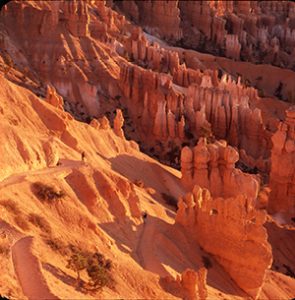
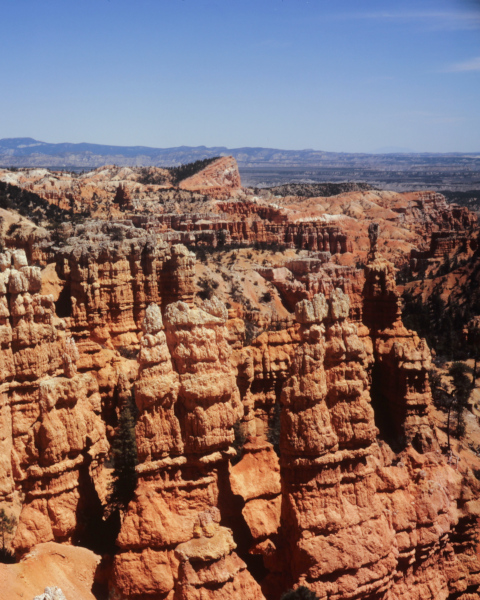
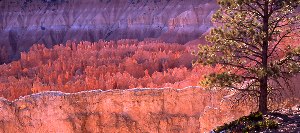
    This is an image that was destined for the wastebasket. Most of the image area was boring, showing loose slides of gravel, and the corner of a metal fence I hadn’t noticed. But when I stuck it in a pano mount — magic! I love the subtle colors — it reminds me of an old theatre set. To me it’s alchemy, when you’re able to take something that’s not working and spin it into something beautiful. I like this slide a lot, but maybe that’s because I rescued it
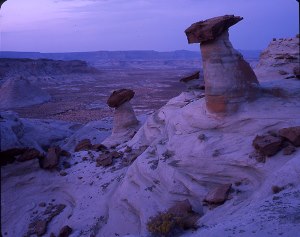
  • Stud Horse Point #4
    Twin Hasselblad 500Cs • 50mm lenses • Provia 100F • f/22 • shutter speed unrecorded
    In October 2008 I took a vacation in the Southwest US. Mandy (my wife) had less time available, so I drove down a week early to Page, Arizona, and spent some time with photographer/guide Jackson Bridges. This is one of the spots we visited. By the time Mandy flew down to meet me, she’d been spared a long drive, and I had an extra week of photography.
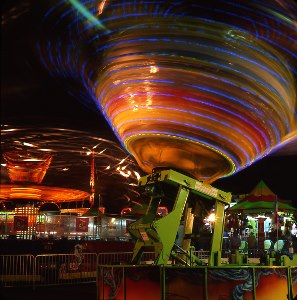
  • Blown Glass Cyclone #1
    TL-120 • Provia 100F • f22 • 8 seconds
    One of my favorite subjects is carnival rides at night. This was shot at the Evergreen Fair in Monroe, Washington, August 2009.
  • Waveswinger & Coaster
    Twin Hasselblad 500Cs • 50mm lenses • Provia 100F • f22 • shutter speed unrecorded
    Shot at the Puyallup (pyoo • AL • ip) Fair, September 2008. Cameras were probably butted together as close as possible, meaning about 4.25” separation between lens centers.