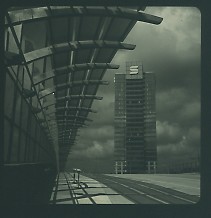
 #34 – Stereflektoskop – Kodak Tech Pan
This is a bridge that goes over Interstate 75 in Atlanta. It was under construction at the time. I thought that the architecture, the angles and shadows were interesting.
Category Archives: FolioA
Chihuly Exhibit
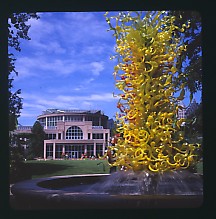 #33 Stereflektoskop – Velvia 50
A shot from the Chihuly glass exhibit at the Atlanta Botanical Gardens from a couple of years ago.
Later in the Evening by the Lake
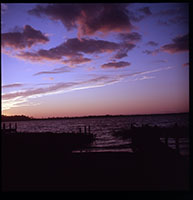 This was taken a few minutes later. (See notes from previous image) By this time, the shadows have eaten up a lot of the closer depth cues, (and apparently my ability to see the bubble level in the viewfinder) but there is still some sense of being there. It will be interesting to see how the digital slides compare noise-wise to this one.
According to the 3D World mounting jig, the vertical alignment is either perfect, or off by a bit, depending on which side of the slide is up in the jig. I suspect this means the lines on the jig are off by a hair. Please let me know what you think.
I haven’t been able to do much shooting the past two years, but I hope to make up for lost time on the next loop. Thanks for your patience, and for sharing some amazing images.
Early Evening by the Lake
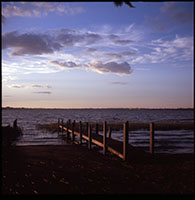 I was juggling the Heidoscop, and a couple of digital rigs hoping to get a set of digital->film comparison slides printed up for this loop. Hopefully the digital slides will catch up with the folio before the next stop is over.
In order to reduce the severe headaches I’ve been getting during mounting, I’m experimenting with keeping the edges of the chips lined up in between the two horizontal ridges in the 3D World mounts. This has been a huge help, but in this particular case, the downside was that the horizon is a little bit tilted, and there is a bit of tree branch dangling down at the top that I would have masked w/ the mount if I could have slid and rotated the chips a little bit.
According to the 3D World mounting jig, the vertical alignment is either perfect, or off by a bit, depending on which side of the slide is up in the jig. I suspect this means the lines on the jig are off by a hair. Please let me know what you think.
I haven’t been able to do much shooting the past two years, but I hope to make up for lost time on the next loop. Thanks for your patience, and for sharing some amazing images.
Oranges
It took several trips into town and a couple of different groves before I managed to get there when they were ripe enough, not already picked, and the sun was still high enough that the rows weren’t casting huge shadows on each other.
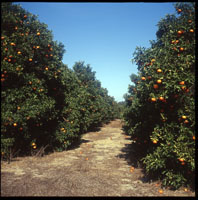
According to the 3D World mounting jig, the vertical alignment is either perfect, or off by a bit, depending on which side of the slide is up in the jig. I suspect this means the lines on the jig are off by a hair. Please let me know what you think.
I haven’t been able to do much shooting the past two years, but I hope to make up for lost time on the next loop. Thanks for your patience, and for sharing some amazing images.
Misty Morning Out Standing in Someone Else’s Field
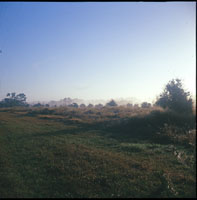 It was an unusually misty morning, and I wanted to experiment with the back-lit dew, but I didn’t want to seem like I was being too nosy about “The drug dealer shack” on the other side of the field, so I had to settle for semi-backlit. A few years ago, this was an orange grove like you see in the next slide.
According to the 3D World mounting jig, the vertical alignment is either perfect, or off by a bit, depending on which side of the slide is up in the jig. I suspect this means the lines on the jig are off by a hair. Please let me know what you think.
I haven’t been able to do much shooting the past two years, but I hope to make up for lost time on the next loop. Thanks for your patience, and for sharing some amazing images.
#4 Portland Oregon, Japanese Garden
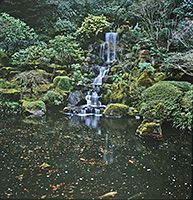
Portland Oregon, Japanese Garden
#3 Columbia River Waterfall
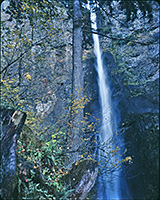
Columbia River Waterfall
#2 Waterfall on Columbia River
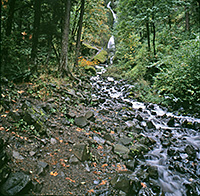
Waterfall on Columbia River
#1 Columbia River Waterfall
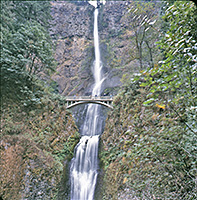
…and the Clock Struck KAZAM! #2
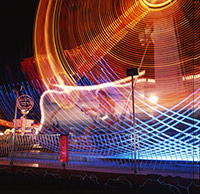
Carnival rides light up the Puyallup Fair at night
I have my night exposures of carnival rides pretty well set, but this particular ride was running without the spotlights for most of the duration of the ride. It looked darker than usual, so I bumped the exposure. Taken with twin Hasselblad 500Cs, 50 mm lenses. Exposure could have been 16 seconds at f22.
The top part of the ride is swinging down, and looks to me like the pendulum on a clock. It intersects with Sinbad’s extended sword in the painted backdrop. It looks as though he’s hitting the pendulum with a loud KAZAM!
Canyon X Colors #34
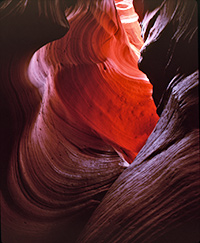
Reflected, unfiltered light in Canyon X
Last year I was on a break between contracts, and Mandy saw a window of opportunity to sneak off for a vacation. Picking the southwest US was easy. She had only 2 weeks available, but I was free as a bird, so I offered to drive down to Page Arizona a week early. That gave me a few days to spend with a photo guide, Mandy flew down to meet me, and we took it from there. I’ve seen shots of Antelope Canyon for years, but I had no idea what a tourist trap the place has become. When I went to Antelope, which is a fairly short Canyon, there were 200 other photographers crammed into this tiny space elbow to elbow.
I also went to Canyon X, which only one tour company has the rights to visit, and it was a completely different scene. Unfortunately, most of the day at Canyon X we were getting filtered light, but there were some lucky breaks, like this one. It’s all reflected light bouncing around. There’s no surface in this shot getting direct sunlight. I metered off the highlights.
I think this makes a nice complement to John’s ice cave.
Above Lake Viviane
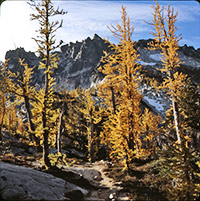
Golden larch in the Alpine Lakes Wilderness, Washington
Mandy and I went on a backpacking trip into the Alpine Lakes Wilderness in September 2007. Permit required, hard hiking, heavy pack, uncooperative weather. The whole point for me was photography, and by 3 days in I had taken 1 stereo pair in 35mm. Winds died down some on the 4th day and I went nuts with the picture taking. This area is known for its pristine lakes, granite peaks, and larch turning gold in the fall. It’s a stunningly beautiful place.
This was taken with my Sputnik, tuned up by Don Lopp. Thank you, Don! Please forgive any mounting errors — the focal lengths of the lenses are a little mismatched.
Tornado Bubble #10

Tom Noddy and the Tornado Bubble
In the last loop, I included a shot of my friend Tom Noddy with one of his marvelous bubbles. That was shot with the TL-120 and some bounce flash, but when I tried to figure out the exposure, I made some gross errors. So why did the pictures come out okay? I apparently made a whole bunch more errors in making my settings. Yes, I’m an idiot. But I’m an extremely lucky idiot.
This year I did some test shots before inviting Tom over again. There’s black velvet hung behind, because the DOF is extremely shallow. I think we had sharpness between about 28 and 32 inches. I had several flash units triggered by slaves, mostly bouncing off the ceiling here. (I’ve been reading the strobist blog a lot lately, and trying to learn more about the use of flash.)
To create this, Tom blows a bubble and catches it on the wand. He blows a second bubble below it, filled with smoke, so the smaller smoke bubble is attached and hanging below the clear bubble. Tom sticks a wet straw through the wall of the top bubble and blows gently, so the air is swirling inside. Then he break the membrane between the 2 bubbles, so now the smoke is inside the bubble with the swirling air, and the smoke is still somewhat concentrated. Finally, he opens a hole in top of the bubble, so the bubble deflates like a balloon, forcing out the swirling smoke. I shot a bunch of these. Every time you shoot one, you watch what it continues to do, and you think, “Dang! It got even better after I fired!”
I like the detail of the swirling smoke, and the saturated colors on the top of the bubble.
Sixth floor museum Dealy Plaza Dallas
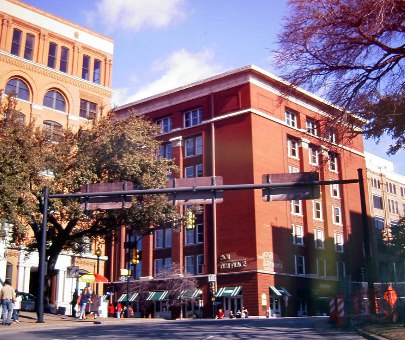
This was taken with the Don Lopp tuned up sputnik. Shot on 1-3-09. The colors look off to me, too much magenta. The depository is the left hand building. The 6th floor window is one floor below the top of the structure. The window that Lee Harvey Oswald allegedly shot from is the square shape window to the right of the row of arched windows.
Constructed in 1901, the red brick building on the corner of Houston and Elm streets was known as the Texas School Book Depository at the time of the assassination of President John F. Kennedy. The private firm stocked and distributed textbooks for public schools in north Texas and parts of Oklahoma.
Following the Kennedy assassination, the building became the focus of shock, grief and outrage. Evidence was found showing that shots were fired from the sixth floor, and Depository employee Lee Harvey Oswald was charged with the president’s murder.