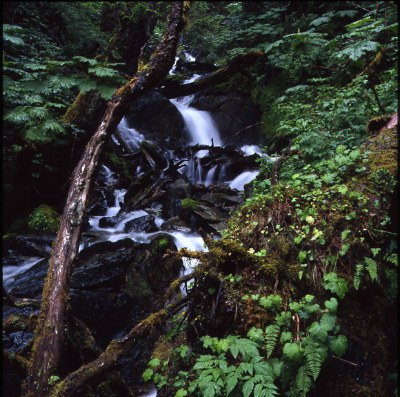
 You might be tempted to misidentify this as your basic, Southeast Alaska, rainforest stream. There are so many of them, it’s hard to get anywhere without having to find your way across a couple dozen of them. But this, I’m sure, is the home of an elusive Water Nymph. I’ve tried numerous times to catch a glimpse, but I’m always disappointed. I probably make so much noise getting through the undergrowth, that she’s able to make herself scarce before I arrive.
Tag Archives: TL120-55
Where the Rain Fell
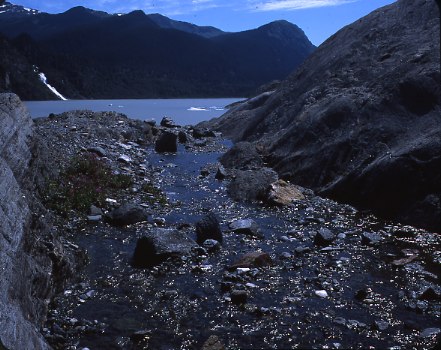 In the summer of 2015, I did another long walk looking for tripod holes. I load my pack with a TL120, a digital SLR, maybe a W1, a box of slides, and a STL viewer. The task is to find the locations, and recreate the view. The challenge is to make an engaging image in a location which probably no longer has the jaw dropping magnificence of its youth.
It is hard to suppress the cringing and pain I feel as I search for tripod holes. I have a visual memory. My trek across the barren rock is a long slow playback of previous excursions, narrated by my little voice, “I remember when . . .”, “We forded the stream up there . . . “, “This used to be . . .”.
This location happens to be where 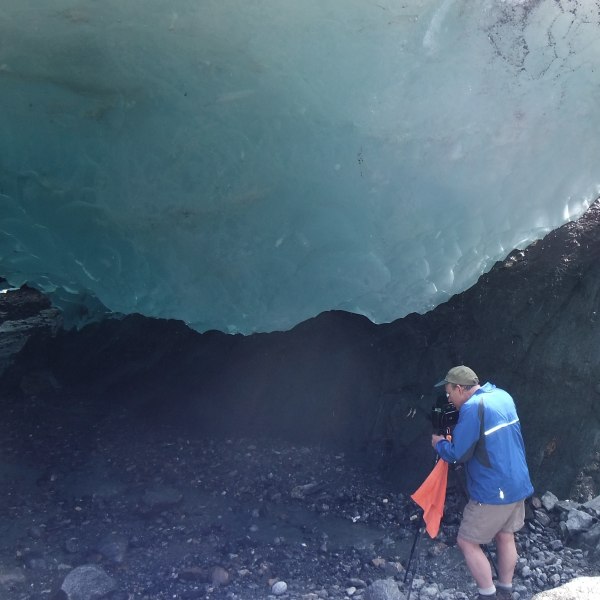 I made some of my favorite images. I know one made it into the folio. Others, including Raining Tunnel, made their way into a slide display at the NSA convention in Colorado. The camera location recorded in this thumbnail (from 2010) is just about where the cliff wall exits the right side of the stereo view. In this case, I was unable to create any meaningful image by putting my tripod back into those holes. I chose, instead, to move my camera to the vantage point from which I had made the 2010 self-image.
In 2010, the water ran into a ice tunnel of uncertainty and opportunity. I knew it fell into the lake somewhere, but how far would I venture into that tunnel to find and capture images. In 2015, it is a spread of certainty. The fireweed and willow have taken root, the stream runs in the open, and a Southeast rain forest will soon own this location.
On Spaulding Meadow
The Spaulding Meadows are popular all year round. These are not meadows with cultivated hay fields. These are meadows in the second sense of the word, being areas of grass and flowers near the treeline. In the winter, they are very popular ski destinations, but the snowfall was so scant this year that there was virtually no skiing at all. They will often have snow in them until May, but by February 2015, the snow was gone. The images in this set are from a pair of trips I made to try to capture the combination of snow-free meadows and low-angle light.
 Spaulding Ponds
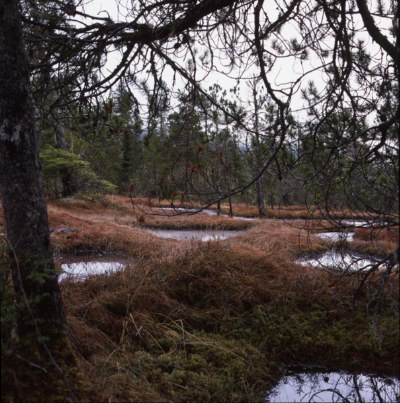
The ponds and pools in the meadows were still solid enough to walk across, so it made for very easy access to all corners of this space. I nestled in under a couple of trees to try to capture the frosty glint on the branch tips. I provided a little bit of fill-flash in an attempt to brighten the gloom under the trees.
 Two Towers
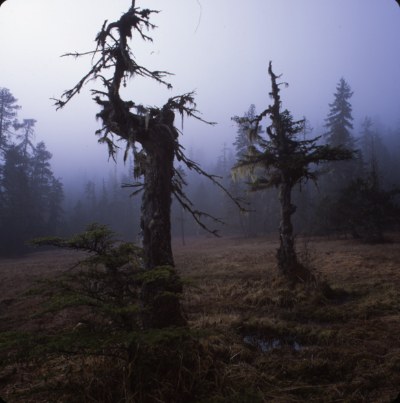
Despite the level of the clouds, I think you can gauge the height of the sun. This was about noon, so you can see that the sun doesn’t get very high in Juneau in the winter. I think this image effectively contains infinity without containing a horizon. This is a very common condition in Southeast Alaska. The weather is very close and we are often hiking in the clouds at less than 1,000 of elevation. This image was made at about 800‘ with my TL120-55.
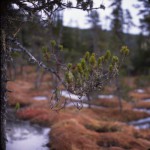 Spaulding Close Up
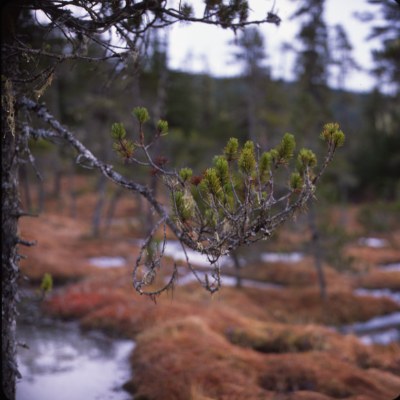
While enjoying a cup of tea and taking in my surroundings, I found myself staring at a tree. My attention was drawn to a low-lone branch. And further drawn to the tufts of needles on a twig on that branch. And here it is. I would have liked to close in on a single tuft, but the TL120-1 can’t focus closely enough.
Fiery Depths
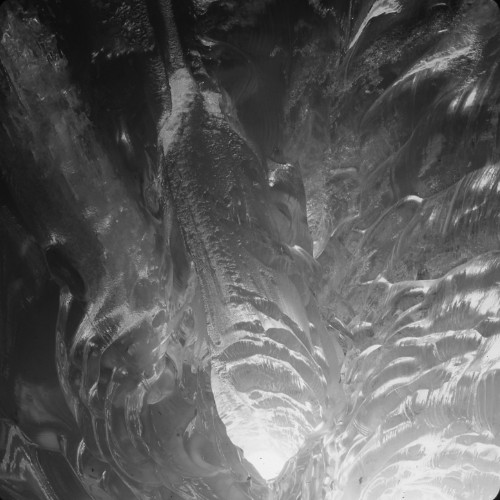
Fiery Depths
Looking down into the pits of hell, are those the screams of your political opponents you hear? Maybe it’s only last night’s burritos talking.
Regardless, I don’t want to be pitched over the edge.
TL120-55, Ilford HP5, DR5 processing (Yes, I typo’d the title on the mount, but given the scarcity of mounts I didn’t feel the need to remount in a clean one.)
Death By Ice Cream
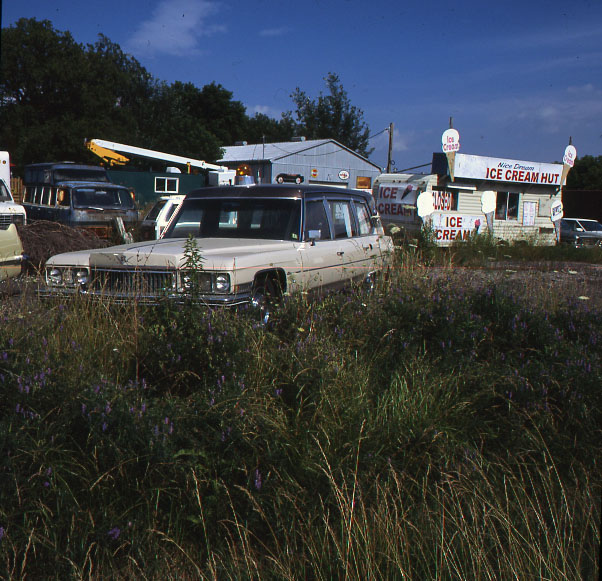
Who doesn’t like ice cream, and who doesn’t like funeral cars? This shot has both! Shot with a TL-120-55 on RDP III.
Riveted

My friend Rick was shooting a bridge near Cherry Street in Toronto and invited me down. Apparently a road crew was about to refurbish the bridge, so we thought we better capture the peeling paint while we had a chance. Shot with TL-120 modified with Sam Smith’s 55mm conversion Mamiya lenses on Fuji film.
Final Rusting Place
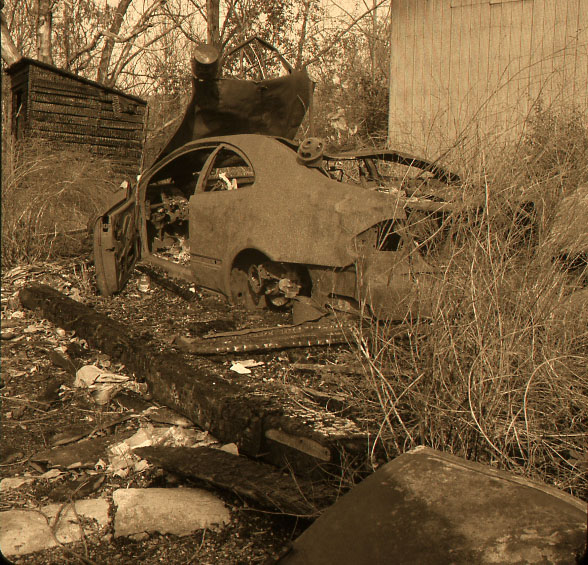
Approximately once a year dr5 offers “Dev2” service, which is basically sepia processing. The only Fuji film that can be processed in dr5 is Neopan 400, and at that only in Dev2. When dr5 announced the limited availability of Dev2 last year, I grabbed the only roll of Neopan 400 I had, and drove out to the airport. Behind a strip mall row, beside a dilapidated parts factory, resided a trio of desecrated automobile shells. This was part of that day’s one roll shoot. Shot with a TL-120 modified with Sam Smith’s 55mm conversion, on the aforementioned film using a handheld meter.
Looking Through the Ice
 This is a different kind of ice shot. This is a glacier segment which has calved, floated out into the lake, and been trapped in the lake ice when winter arrived. We skated out to the trapped bergs, before shedding our skates to investigate. It was at least 15′ from the surface of the lake to the tunnel roof.
Based on the size of the tunnel, and the shape of the scallops on the walls, I suspect this began as a vertical shaft (moulin) draining water from the surface of the glacier to the interior. The wind and sun continue to work on the ice even in the winter.
Tripod mounted TL120-55
Windows on the World
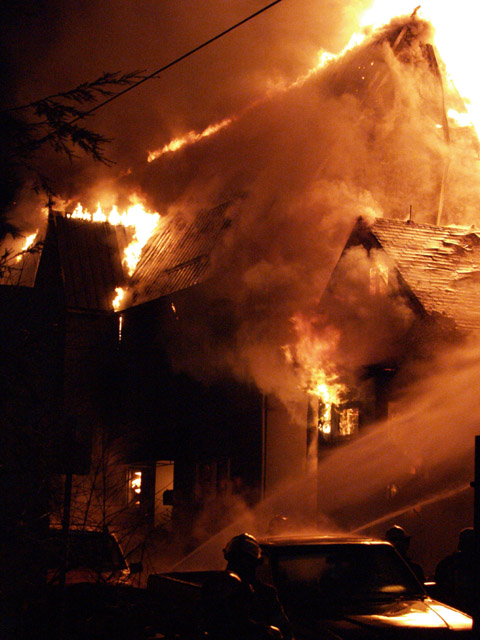
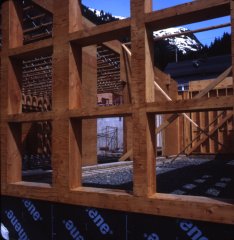 Several years ago (2006), a disgruntled man set fire to a homeowner’s boat (on a trailer behind their house). The fire spread to their house and the adjacent church and burned both to the ground. If the winds had been different, a large section of Juneau could easily have disappeared that night. Three years, and many contributions later, enough of the church had been rebuilt to begin services again.
This was shot from the sidewalk during reconstruction, probably hand-held, during a noon-time walk.
Not Too Close / Plowing Prow
The winter ice has been terrible at the Mendenhall Glacier this year. The combination of snow, rain, and avalanches has meant I haven’t ventured near it, much less tried to cross it to get new winter images of the glacier. These two views from 2008 (captured with my TL120-55) will have to suffice. The area of ice pictured here is now long gone. In the summer it is open water. In the winter, it is lake ice.
Not Too Close
This image is taken about a mile and quarter across the lake from where I laced on my skates. Because of the current lake level, 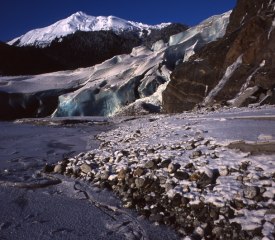 there is a patch of stable, rocky beach here. Because of cliff and creeks, it isn’t possible to walk around the lake to get to this bit of beach. Crossing the lake is the only way. Everything off that bit of beach is in flux and subject to change at any moment.
The cracks parallel to the shore show that the lake ice has sunk, and may again. The white froth beside the green glacier is a flowing and frozen waterfall. There is another stream coming down closer to the camera. Both are flowing under the ice, taking relative warmth, and creating areas of thinner lake ice. The glacier is calving from above and below, even in winter. Because of all this, approaching the glacier is a dance with an uncertain beast. I hunt for images and capture them as I approach, never certain when I’ll decide I’ve gone close enough and its time to retreat.
This image was made early in the morning’s dance. The colors and textures beckoned me closer despite the poor ice conditions.
Plowing Prow
Closer (and farther to the left) than the previous one, I captured this image. My exploration is stymied. The lake ice has been broken and refrozen several times, 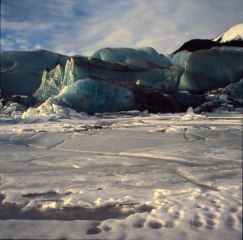 and there is water between the farther cracks. The advancing glacier has plowed up the lake ice like I might my driveway. Farther back there are pieces of lake ice resting 10′ out of the water, having been lifted there by the rising glacier. The textures in the ice in front of me still beckon, but I declare the dance done and retreat.
Return to Nugget Falls
Back in loop-17 (2005?), I contributed a couple of images taken from midway up Nugget Falls on the Mendenhall Lake. I liked the subject and wanted to try with wider lenses.
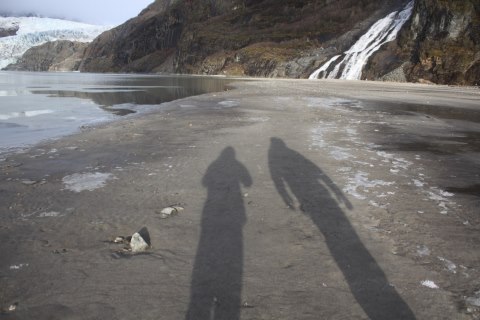
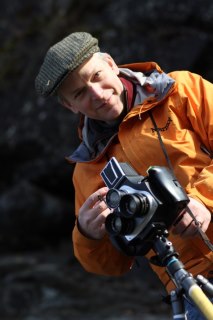
In November 2011, I went back with my son and we both shot some images. A couple of his shots are provided here to help set the scene. I was using my TL120-55, he was using a Canon 7D.
 |
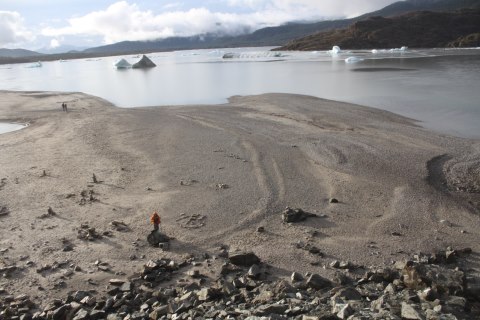 |
It was November, so the lake was just starting to freeze and the sun was low even at mid morning. He climbed up the scree pile beside the falls while I loaded film and prep’d my gear on more stable ground. Then I came up shot a roll looking across the face of the falls, across the freezing lake, and into the powered sugar covered mountains.
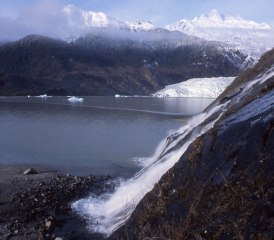
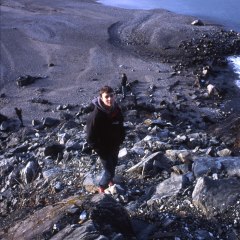
Stuart caught me while I was framing, so after I had shot my scenics and was climbing down, I turned the camera on him. I had already slung my tripod for the descent, so this was a hand-held shot (with neck strap).
 |
 |
The other visitors to the falls were a fortuitous accident. But when I saw them down below, I stalled my framing for a few seconds hoping they would spread to better fill the frame. My gamble paid off and I was please with their contribution to the image.
Maia C 105
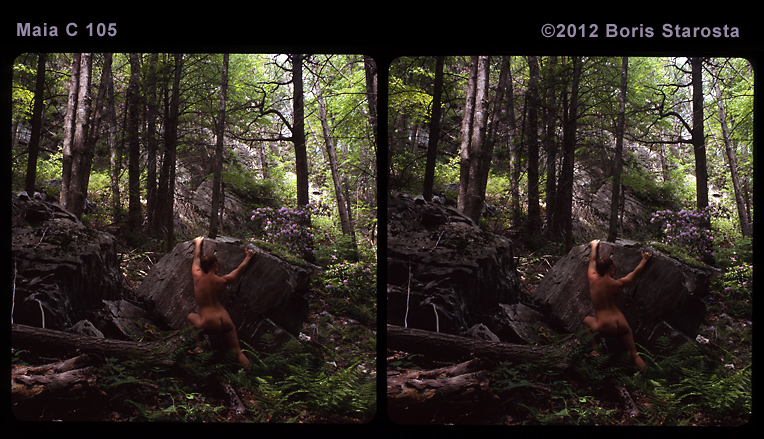
Date: May 2012
Tech:
Available light exposure of 1 second on FUJI Astia RAP100F film, at f22, with a modified TL120 (65mm lenses) on loan from John Thurston. This is the original slide.
Notes:
Chuck Holzner was also along on this expedition with a model, whom we took hiking in St. Mary’s Wilderness, just south of Afton, VA via the Blue Ridge Parkway. We ended up hiking down a trail about two miles before finding a pretty spot with a waterfall. This shot was taken along the way, when we spied some impressive looking boulders. We tried to get this done early enough in the year to avoid full foliage (looking for dappled sunlight), and also lots of other hikers. We mostly succeeded. There was still some sun in places, and only one couple of hikers disturbed us briefly, while we were working. Chuck nearly had a heart attack climbing out of the valley, it was so steep.
Bremo Power Plant Far Room
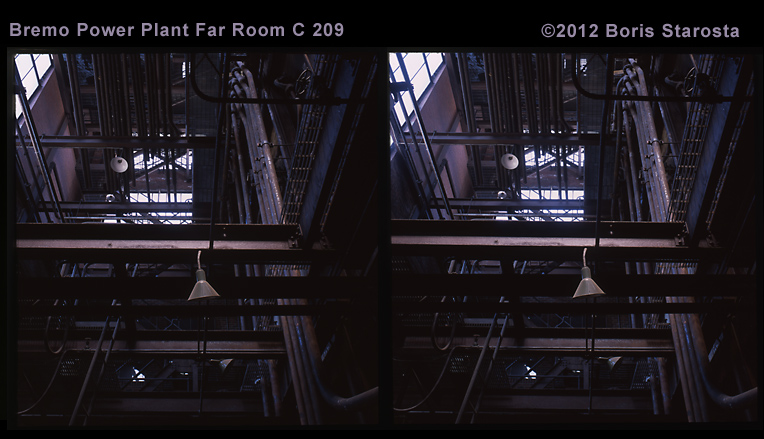
Date: April 2012
Tech:
Available light exposure of 1 second on FUJI Provia RDPIII film, at f22, with a modified TL120 (65mm lenses) on loan from John Thurston. This is the original slide.
Notes:
Earlier this year I had the chance to photograph inside an old coal fired power plant. Chuck Holzner and I travelled to the plant three times with various MF and digital cameras, and this slide is just one of probably over a hundred made coming out of those expeditions. The plant is in Fork Union / Bremo Bluff, VA, and was built about 1930. It was the first plant to be built with an “automatic” central control room. That means that valves, pumps, and other control elements could be remote-controlled electrically from the control room. This plant was decommissioned in the 1950s and now sits adjacent a newer plant.
Tours!
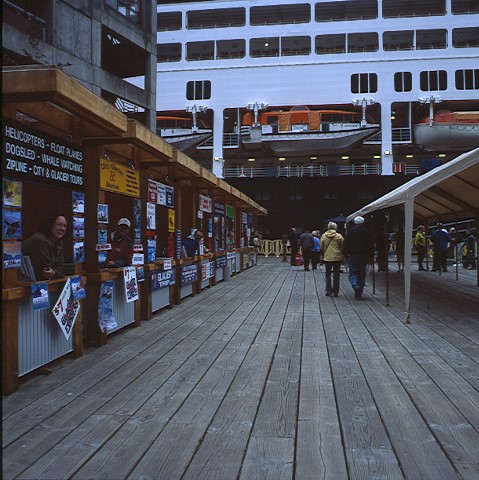 Down on the docks, the cruise ships tie up and the passengers disembark. Those who bought package tours on the ship need to find the right person with the sign for their tour. Those who didn’t buy their tickets on the ship, can talk to one of the tour representatives in the kiosks. The cruise lines would rather sell the ticket on-board (as they pocket a large commission on each sale), and make a point of warning their passengers of unscrupulous dealings elsewhere. I’d rather deal with these guys who are here rain or shine, every day of the week.
This was a fun image to make. I was framing the image and chatting with the barkers in their kiosks. All day long, they see the tourists clicking away with cameras, but my TL120-55 on a tripod was a bit different and caught their attention. I tried framing this with the TL120-1, but I really think the 55mm lenses let me better capture the scene.
Tripod mounted TL120-55, April 2010.
Glare From the Noon Light
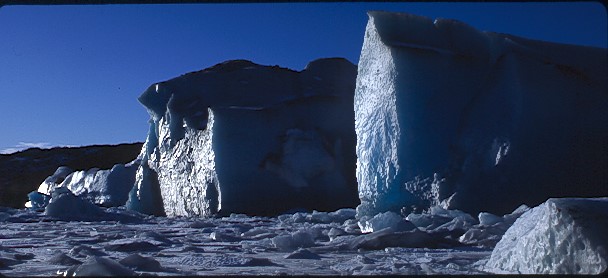 Yes, this is the noon light, not the moon light. Early in January, the sun doesn’t get very high in our sky. It rakes in very low, and there are often shadows mid-day caused by the sun being obscured by some mountains. In earlier folios, you have seen where the ice meets the land. This is where the ice meets the lake.
Catching the dawn light on the glacier is a tricky business. By definition, it involves starting the mile and quarter trek across the lake (either by skate or by ski) before dawn. It requires a bit of nerve to lace up my skates and set out across the lake in the dark with a pack loaded with camera gear. Once there, in the pre-dawn light, the challenge is to find the image that will be there when the sun arrives.
In this case, I caught the light on the extreme face of the glacier. There is nothing for scale, but the hummock to the right is probably only four feet high. That makes the face about 30 feet high. The lake ice in front of it (as well as where I’m standing) is a mass of re-frozen crumble. At any time, the glacier may slide forward and wrinkled the ice for many yards. The lake is also littered with bergs which have fallen off the face. If that should happen, the resulting waves will leave broken ice for half a mile. I have never been there when it happens, but the evidence that it does happen is recorded in the ice at my feet.
This was shot with my TL120-55 on a tripod in January, 2010.