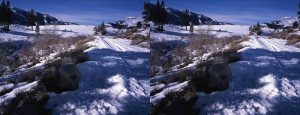
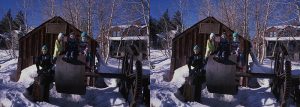
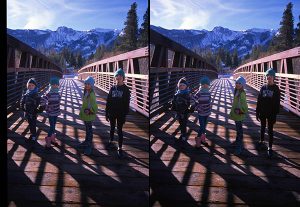
Due to the pandemic, my road trips to the States have been curtailed and limited to shorter journeys within my home province of Ontario. With all of the beautiful Saskatchewan vistas and the spectacular travel photos that were featured in the recent go ’round of the folio, I felt that Ontario should also have a chance to show off some of its breath-taking scenery.
“SLIDE AND THE FAMILY STONED”
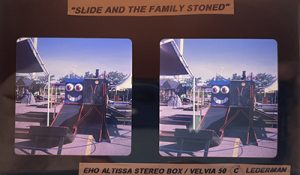
Who needs to travel to Kingston, Jamaica when you can easily drive to Kingston, Ontario? On the way to Kingston, why not stop in Napanee? Napanee is so named for the unusual practice of its residents, who kneel while sleeping, which incidentally is not the same as sleeping while kneeling. Napanee is full of pastoral views, such as this parking lot amusement park, seen here via an EHO stereo box camera. The Altissa-EHO Stereo box camera was manufactured in the ’30s and has no provision for focusing. It has a choice of two Waterhouse f stops – f11 and f22. This image was shot using the EHO’s original single shutter speed of (I believe) 1/30th of a second. The camera has visited a technician in the interim and has had its spring tensioned so that now it is capable of firing its shutter somewhere between 1/60th – 1/100th of a second!! Captured on expired Velvia 50 and home-processed with a CPP2 Jobo unit.
“THEIR SNOW BUSINESS”
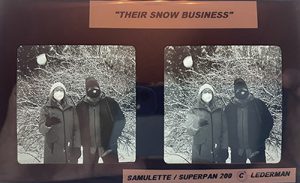
Meet Lorrie and Ray Dillard. They reside in Barrie, Ontario, which is very far North of anything and above the permafrost line. Lorrie and Ray run a successful snow-harvesting business, selling their surplus snow to countries around the world that won’t or are unable to grow their own snow. The snow is shipped out via husky-powered sled in small individual manila bubble pack envelopes twice daily. Lorrie and Ray hired Ethel Merman to sing their social media jingle; “Their Snow Business! Like ‘Snow Business’!” This image is from a test roll I shot to determine if Rollei Superpan 200 could be reverse-processed in the sometimes-available Foma reversal processing kit. Captured with Sam Smith’s conjoined AGFA Isolettes (the “Samulette”) on the aforementioned Rollei Superpan 200, and home-processed with a CPP2 Jobo unit.
“THAT’S IT (IN SPANISH)”
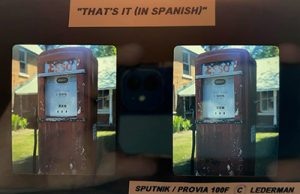
People not your thing? How about taking a road trip to Cooper’s Falls, Ontario? This here gas pump is one of the most photographed entities in an almost-ghost town with not that many entities in it. Approximately 14 houses in the area are still inhabited, and the waterfall after which this semi-ghost town is named cannot really be seen (or photographed) without trespassing, as it is situated on private property. The title of this image is of the crossword puzzle question type, and by request, I am not supplying the crossword puzzle answer here. Captured with an as-fine-tuned-as-is-possible-with-a-Soviet-camera Sputnik cobbled together of donated parts, on expired Provia 100F and home processed with a CPP2 Jobo unit.
“SCREAMING HEADS OF MIDLOTHIAN”
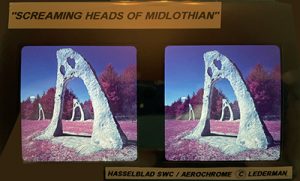
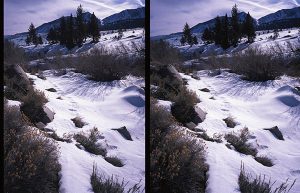
Every year, Worldwide Pinhole Photography Day falls on the last Sunday in April. It is an excuse for my daughter and I to spend a day together photographing various locations in Ontario using pinhole cameras. I will usually pack a “lensed” camera in addition to my pinhole camera(s). On WPPD 2019 we visited artist Peter Camani’s residence which hosts his grand scale outdoor art exhibition. There are various shapes of cast concrete screaming heads situated throughout his 310-acre property near Burk’s Falls, Ontario, each sculpture being in the 15-20 foot tall range. On this occasion I had packed my Hasselblad SWC, and I can’t remember if I was consciously trying to capture a stereo cha-cha image or not. In any case, I found an uncut roll of film with three pairs of images that looked like they might work as stereo pairs. Despite some anomalies between the left and right chips, my brain can fuse these images into a stereo image. As John Thurston likes to say, “your mileage may vary”. Hasselblad SWC, yellow or orange drop-in filter, expired Kodak Aerochrome film, home processed with a Jobo CPP2 unit.
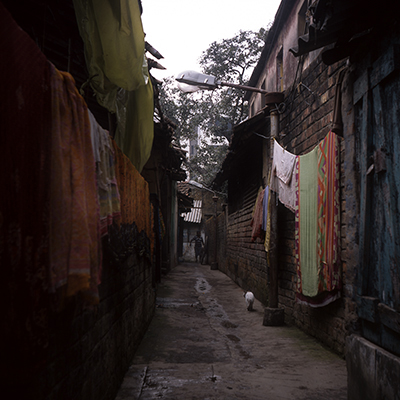 Kolkata is a very interesting city in India to visit. It doesn’t even remotely feel like Delhi, or even Mumbai for that matter. In fact, it feels like a whole different country comparatively. Being a colonial capitol at one point, it has a different ‘air’ to it. But it still has it’s alleyways, busy shopping and dealers districts. This picture was taken in an area that was very close to the house that Mother Teresa had founded to help the sick and the poor in India. We may have even visited her grave the same day that this shot was taken. I would love to go back and photograph these areas again with their endless streams of people going about their daily lives. This was one of those shots where I looked down an alleyway and had to get a shot of it. There are endless photo ops in India, but the alleyways are especially nice in 3D in my opinion. Shot with my Sputnik on Fuji Provia 100F film.
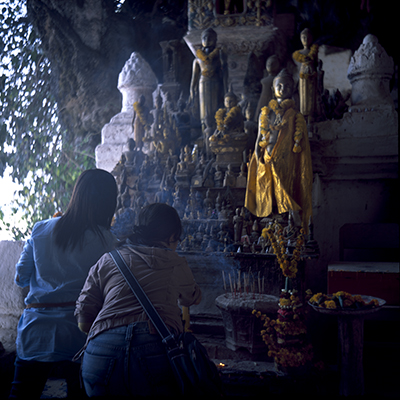 The Pak Ou Caves are located along the Mekong River near the town of Pak Ou in Laos. We visited this area near Luang Prabang, with Luang Prabang being one of my favorite places I have ever visited in Southeast Asia. The cave itself wasn’t very big, and the fact that it was filled with tiny Buddhist statues from many worshipers over many years made it seem even smaller. Luckily there was enough light that was coming in from the entrance to get this shot. What makes this one of my favorite shots I took of this location, was that you could see the smoke rising from the incense and the tiny fire in the lower part of the frame. My Sputnik failed me a little in this picture however, in the fact that it was sharper on the foreground in the right image, and sharper in the background in the left image. The image still works for me as 3D, but it may not work for everyone. This was taken with my first Sputnik, and before any real adjustments were ever made on it. Shot on Fuji Provia 100F film.
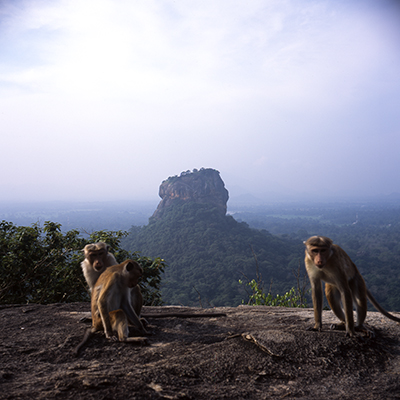 Sigiriya meaning ‘Lion Rock’ is a giant rock structure that is surrounded by jungle in the middle of Sri Lanka. It’s like nowhere else that I’ve been and something out of an Indiana Jones movie. We stayed in a tiny hostel which was so close to Sigiriya that you could see it from our hostel room and within walking distance to the entrance. Luckily we were told that the place opened at 8am by our hostel hosts, which was not what our guidebook had said. The book said that it opened at 9am, and the place was FULL by 10am with busloads of tourists. We were literally the first people to walk in and what an amazing experience it was! There are two Sigiriyas, people called them Little Sigiriya and Big Sigiriya. The big one is what you see in the distance (standing at over 600 feet high) while we were standing on top of little Sigiriya. What was great about little Sigiriya was the fact that it was a jungle hike to get there and much cheaper to visit. If you ever go there, I highly recommend visiting both since they both offer different and amazing experiences in their own right. The structures located on top of big Sigiriya are the foundations of former fortresses and the home of the king of the region, named King Kashyapa who reined in the mid 5th Century. After his death it became a Buddhist monastery until the 14th Century. It’s now a UNESCO World Heritage site and hopefully well protected for many more years to come. These Rhesus monkeys you see here were a little out of focus, I must have been too close to them, or didn’t stop down my aperture enough to get them all sharp. Either way, I still like the shot and hope you do as well. Shot on my Sputnik on Fuji Provia 100F film.
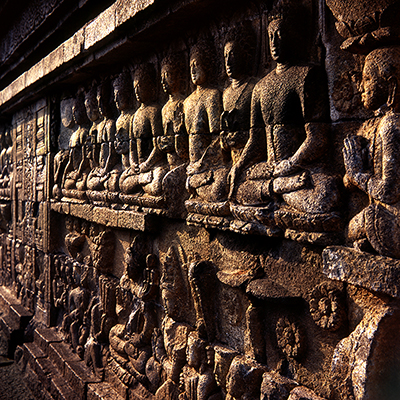 Borobudur is the largest Buddhist temple in the world. Located in Central Java, Indonesia, it’s a wonderful place to visit. Before heading to Indonesia, I wanted to make sure to put this on my list of places to visit. It’s an incredible temple with layers and layers (like a layered cake) representing the different stages of enlightenment to reach a final state of Nirvana. It was built originally in the mid-8th Century to 9th Century AD. Once it was abandoned and then ‘rediscovered’ by a British Colonist who then hired a Dutch engineer to excavate and rebuild the structure. It took his team over 4 years to rebuild, however volcanic eruptions, erosion, and even terrorists have beat the structure down throughout the years. Luckily, with the help of UNESCO and tourism, it has been restored to as close to what they think it was like in it’s original state as possible. We visited it in a different way at first, in fact it was from a distance that I got a shot of it in the early morning pre-dawn light. The visit consisted of a hike and motorbike ride to an adjacent hillside. We later went back down the valley and into the entrance the same day. Made for a long day for sure! This shot is of a bas relief, one of over 2,600, that covers the structure. A must see if you’re ever in Java! Shot with my Sputnik on Fuji Provia 100F film.
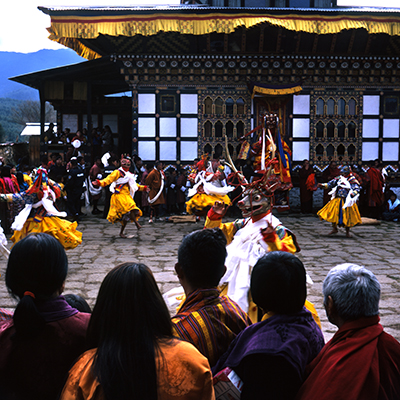 The Domkhar festival is a wonderful experience. Before we left on our trip, we planned our trip around two festivals. Typically most occur in the Spring and Fall in Bhutan, this was in the Springtime. If you do plan on going to Bhutan during those times of year, your travel agent and/or guide will almost certainly schedule in a festival or two for you to see. The area of Bumthang was the furthest east that we travelled in Bhutan, and it’s an area that I would highly recommend. The festival lasts for about 3 days, and we visited on it’s first day. The festival is dedicated to the birth anniversary of Guru Rinpoche, the second Buddha, or more importantly the father of Buddhism in Bhutan. Monks dress as animals and other characters, and display themselves in lavish costumes. They dance in a mesmerizing choreography. We did manage to get a chance to explore the village of Domkhar as well, which felt like you were entering into a time warp going back about 2 centuries. All in all, it was an awesome experience and not your everyday trip to the beach! Shot this with my Sputnik on Fuji Provia 100f film.
 As we walked over the main bridge to the Dzong, a small crowd of monks were walking up a path towards us. Knowing full well that this was a good opportunity to capture them, I ran ahead of my group, as the lighting was nice and dramatic. Happily, I managed to snap a couple shots off before they walked past. What’s great about Bhutan is the sheer beauty and photo-ops at every corner. Unfortunately, you must be accompanied during your entire stay in Bhutan, government rules. Luckily however, it’s a great way to see the country since your guide and driver are always at your beck and call, are extremely knowledgable, and are always striving for you to have a great experience no matter what. If you see a photo op on the side of the road, they will gladly stop! We had them stop actually quite often. We are not used to being ‘pampered’ on our trips, and in fact we are usually quite uncomfortable and ‘unguided’ most of the time, since we tend to travel on a budget. However, Bhutan was an exception for us and since we had no choice but to have a guide, we embraced it with loving arms! If you’re even remotely interested in visiting Bhutan, please message me and I will gladly give you all the details. Shot on my Sputnik, with Fuji Provia 100F film.
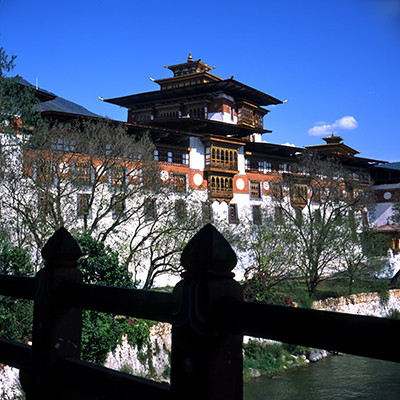 The Punhaka Dzong is the second oldest and the second largest Dzong in Bhutan, and arguably the most impressive. It’s surrounded by a converging river, which adds to it’s splendor. Dzongs used to be fortresses during wartime, but now are used for government offices and a religious monastery. My favorite view of the Dzong is from the bridge leading over the river to the main entrance. This was a more crowded part of Bhutan, mainly because it was closer to the west side of the country, where most tourists tend to gravitate to. This Dzong was by no means, an exception. Due to this, I had to ‘nudge and dodge’ my way over to the railing to get the shot. This was taken with my Sputnik, on Provia 100F film.