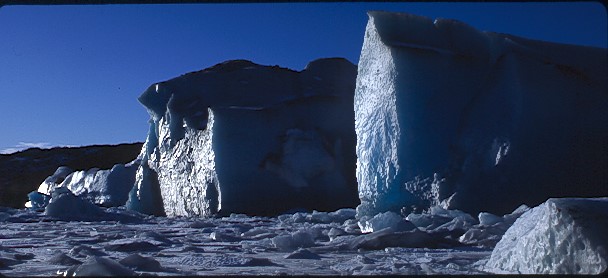
 Yes, this is the noon light, not the moon light. Early in January, the sun doesn’t get very high in our sky. It rakes in very low, and there are often shadows mid-day caused by the sun being obscured by some mountains. In earlier folios, you have seen where the ice meets the land. This is where the ice meets the lake.
Catching the dawn light on the glacier is a tricky business. By definition, it involves starting the mile and quarter trek across the lake (either by skate or by ski) before dawn. It requires a bit of nerve to lace up my skates and set out across the lake in the dark with a pack loaded with camera gear. Once there, in the pre-dawn light, the challenge is to find the image that will be there when the sun arrives.
In this case, I caught the light on the extreme face of the glacier. There is nothing for scale, but the hummock to the right is probably only four feet high. That makes the face about 30 feet high. The lake ice in front of it (as well as where I’m standing) is a mass of re-frozen crumble. At any time, the glacier may slide forward and wrinkled the ice for many yards. The lake is also littered with bergs which have fallen off the face. If that should happen, the resulting waves will leave broken ice for half a mile. I have never been there when it happens, but the evidence that it does happen is recorded in the ice at my feet.
This was shot with my TL120-55 on a tripod in January, 2010.


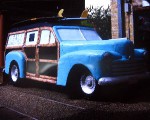 I realize this is a tad dark, sorry. It was taken at the Corpus Christi, Texas surf museum in 2009. The car is made out of fiberglass. And is a replica of the old surfing woody. If you are ever in Corpus the museum is a fun place to visit. Taken with the TL120.
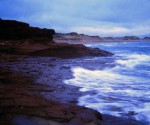 This was taken with the sputnik at Prince Edward Island. I believe the year was 2005.
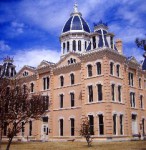 This is the original courthouse in Presidio County, Texas built in 1886. It was restored a few years back. Too bad I couldn’t have people in it as it would be more interesting, like a cop taking in a suspect. But this was early on a Sunday morning. I used the TL120. Settings are rarely remembered. Marfa is the town where the movie “Giant” was filmed. Also, it is well known for the Marfa lights, a nighttime phenomena that we didn’t get to witness.
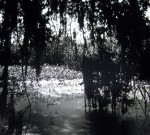 This image was made several years ago at Brazos Bend State Park (Texas) where my alligator shots all come from. I think I used a sputnik and most likely used tech pan. I have no idea what settings were used on the camera.