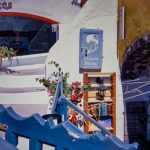
Atlantis Book store on one of the Greek Islands. I must have opened up one stop from Sunny 16 to keep from losing all detail in the shaded store entrance. So, the stark white walls are almost blocked up, but I had to do it -what an amazing scene! I left that Tilley Hat on the airplane, coming home.
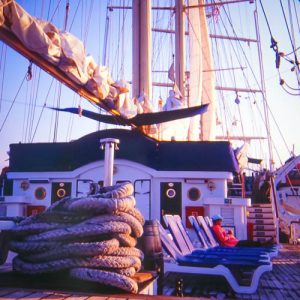
This shot, made early one morning, gives a feel for the atmosphere on the boat. They usually had at least some of the sails up, even when under power. We boarded in Istanbul and sailed/motored to the Islands first, and then on to Corinth and Athens. Our cabin was through those doors behind the rope, and down the stairs. We had a porthole just above the waterline – very peaceful.
I thought this looked a bit saturated for Provia, and sure enough, looking back at the rest of the roll it is RVP100 -Velvia100. I had forgotten that I took any Velvia on the trip, so I mislabeled the view itself. Seems as though Velvia is a good bit “softer” in sharpness than Provia. Consulting the image/data made on my iPhone, using the Pocket Light Meter app,I used 1/60th at f-16.
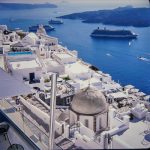
Santorini is one of the Greek Islands we visited during a “Journeys of Paul” tour that Diana and I were on in June of 2017. Our vessel is the sailing craft in the upper left corner of the view, also depicted in Aft-Deck Morn, one of my other views in this round – quite an amazing boat. This was taken with my Sputnik, the only film camera I had on the voyage. Pretty sure I used the Sunny 16 Rule, shooting at 1/125.
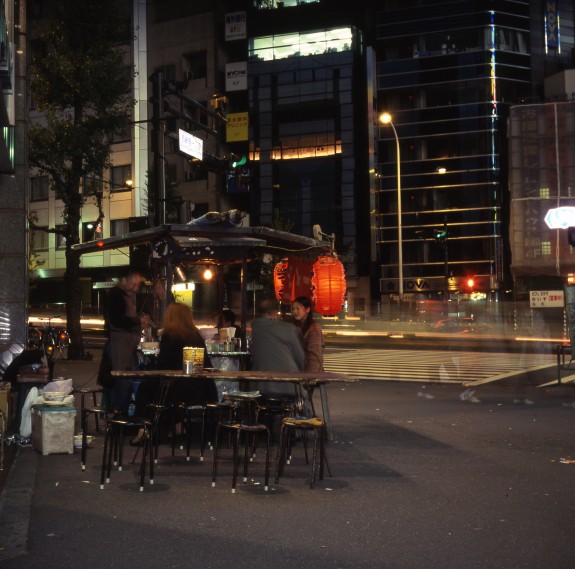
This shot is from 2000, I took it with my carefully adjusted Sputnik with a Vivitar 285H fill flash on a tripod. Probably 8 seconds at f16. This is an example of the terrific results the Sputnik can produce, this is one of my all time favorite slides.
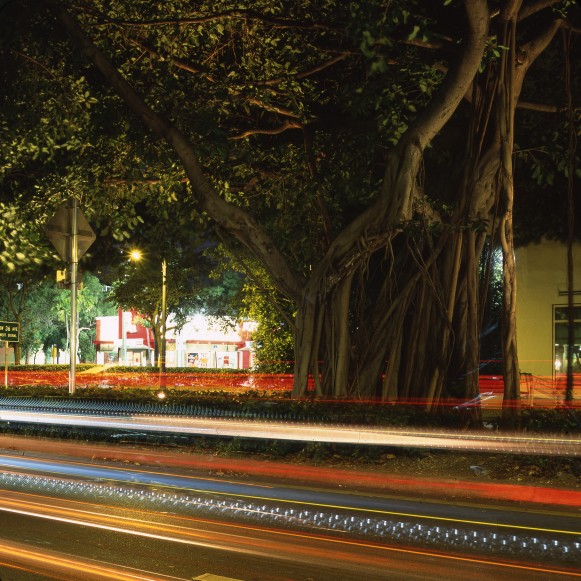
The center island of the Miracle Mile in Coral Gables is lined with these trees. I used a TL-120 on a tripod with a Vivitar 285H fill flash, this was taken after sunset. The fill flash brings out a little touch of detail in the passing cars. I used an incident meter to determine the exposure, hoping to bring out the detail in the trees at the expense of blowing out the store in the background. I think this was a 30 seconds at f22.
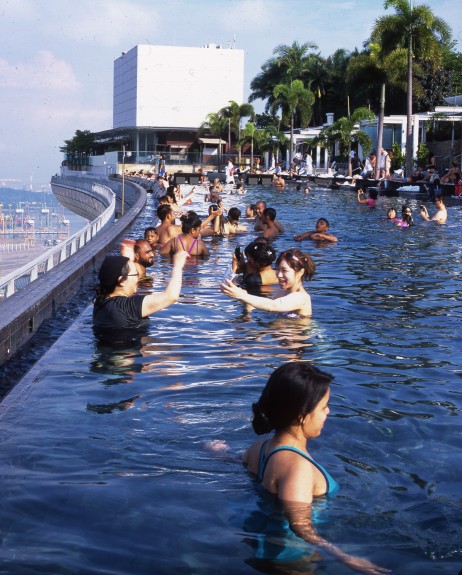
This is the famous Infinity Pool at the top of the Sands three-tower hotel in Singapore. You’ll find a lot of images online of this pool that feature the illusion that the back edge of the water drops off to the Singapore skyline, you’d think swimmers were in danger of falling off. This shot shows why they aren’t.
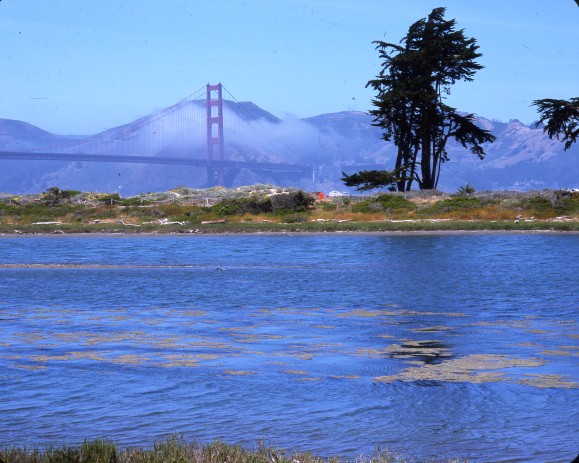
May 2018. I used a TL-120 with Provia 100F pushed one stop.
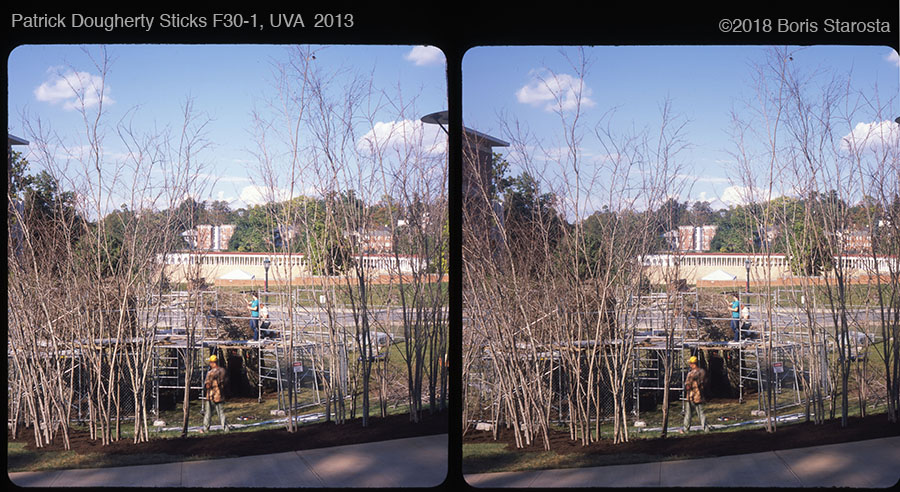
Photographed with twin Mamiya C220 cameras with 135mm lenses. I used Provia 100F pushed one stop. I’m fond of the surreal effect of slightly hyper images taken with zoom lenses. If I take the time to calibrate the twin release cable the Mamiya shutters are easy to sync up. You can see a bird flying in the distance in this shot with no rivalry.
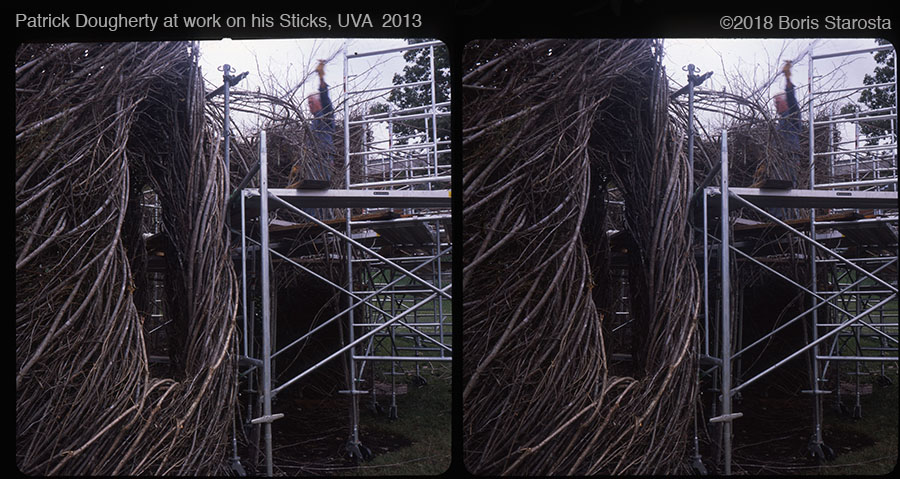
Patrick Dougherty came to Charlottesville a couple of years ago, and I undertook to document his work. If you google his name, you’ll soon find lots of background information that I need not repeat here. Patrick was in town for about a month, commissioned by UVA Arts to make a stick sculpture in the (then brand new) Arts commons, right next to Ruffin Hall (which some of you know as one of my “clear buildings”).
Before his arrival, a crew of local volunteers will have assembled.In his first week, Patrick gets to know his volunteers in the work to gather his sticks.Patrick’s raw material is young saplings.He’ll correspond with people in the area, to find “doomed” saplings – i.e. saplings in wooded areas that are about to be clear cut.So he tries not to harvest saplings that would otherwise grow into mature trees.
After a week of gathering saplings with his volunteers, the work on the sculpture begins.The first slide shows some of the initial work: saplings have been stuck straight into the ground, pressed into ground some four or five feet if possible.Each sculptural structure will be anchored by a few very large and strong saplings.These will be placed into boreholes that were drilled first. At this point, volunteers keep busy preparing the saplings for integration into the sculpture – which mainly involves removing all the leaves.Throughout the work, more and more saplings are trucked in from whereever they had been cut.
Once the installation’s initial layout is secured with these larger saplings, then the work can proceed with smaller saplings and “sticks.”My (uneducated) impression is that the sculptures are more or less woven into place.It is weaving with sticks.Dougherty uses no fasteners of any kind.No nails, screws, twine, rope, zip-ties, nothing of the kind!Only the sticks. The work proceeds for about two more weeks, at which point the sculpture will be mostly complete.
His structures thus fashioned can get quite large.Although the one he built at UVA was nowhere more than about ten feet tall, others I’ve seen depicted online can be multiple stories tall.They are also very strong.Dougherty typically specifies that his installations should be taken down after a year to 18 months.But for some reason, this one at UVA was left in place for over three years!(UVA wanted to get its money’s worth, and I bet Dougherty had to remind the university to take it down).Surprisingly, even at three years old, the sculpture didn’t look all that bad – it got a little shop worn around the edges, and some of the structures had started to sag a bit.(I should have photographed it at the end of its life, but I failed to do so).
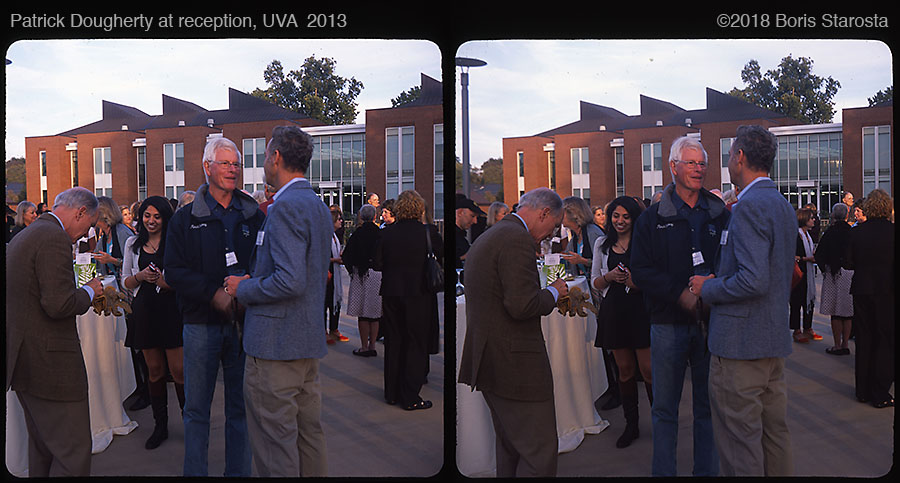
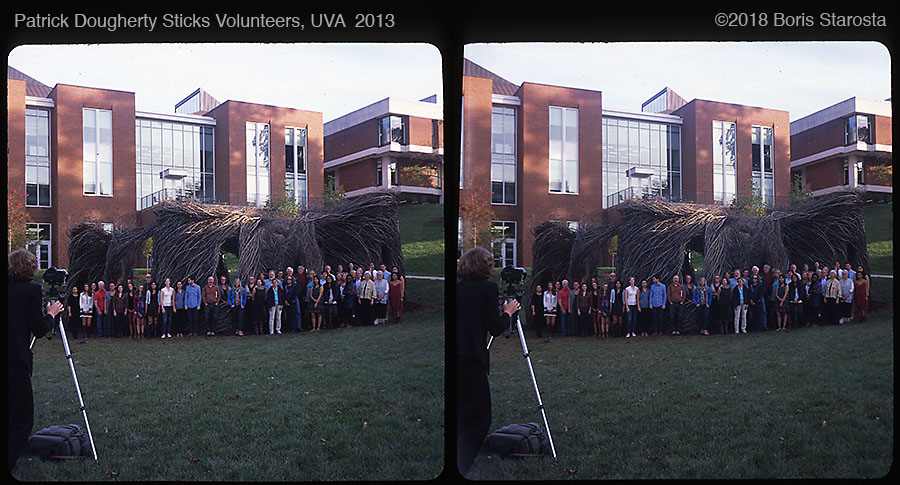
In the fourth week of his visit, Patrick tidies up loose ends and gets ready for his next project.I include a slide taken at a farewell reception, of Patrick talking with one of the UVA big wigs who funded the project; and a slide showing the finished project with all (or most) of the volunteers standing with Patrick for a portrait (that last slide was helpfully exposed by my beloved Michele). Patrick makes about ten sculptures per year in this fashion: one per month, anywhere in the world. Then he takes off two months to be at home with his family.
PS
I did undertake a 3d timelapse of the birth and subsequent aging of the sculpture: I shot two stereo pairs per day for about four months.After an initial review of the imagery, I decided that it was not looking very “good” (constantly and rapidly shifting light was very distracting in the video), so I didn’t do anything more with it.But you can see some of the beginnings of aging, if you look closely:
tube created about 3,000 years ago. It heads south from Mt. St. Helens volcano, stretching for about a mile and a half, narrowing and expanding into a long stretch of total darkness.
My girlfriend and a couple of friends hiked over the top of the tube to the northern entrance of the cave. By doing so, we would be able to walk through the lava tube more or less downhill, to make things a little easier. It takes a bit of time to navigate the tube due to it’s loose rocks and uneven ground. In some spots, you needed to ‘drop down’ a few feet to a lower section of the tube to continue on. This is not a place for people who are claustrophobic or those who are afraid of the dark.
It’s pitch black down there, and very good headlamps are needed to avoid any injuries. For me, this was my second time through the cave and knowing how dark it was, I brought along a pair of Profoto B1 500 watt lights to help fill the space with light.
One of the lights can be seen at the far end of the cave in the photo. This was a mistake mind you, but one that I let slide for the sake of correct exposure, composition, etc. This was taken with my Sputnik on Fujifilm Provia 100f, using a Profoto Air Remote as a trigger. I had also brought along my digital Canon 5D Mk III, but no 3D was taken with it.
If you do happen to find yourself in the vicinity of Mt. St. Helens, have a good set of knees and a decent headlamp, then I would recommend a visit.
There is a way to see a smaller section of the cave, without going the whole mile and a half. I believe it’s about a quarter of the cave, and well worth a look.
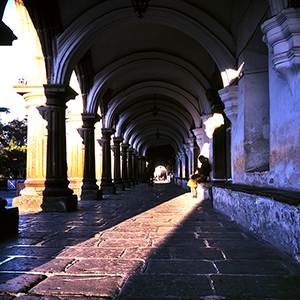
Guatemala is a great place to visit within Central America. We arrived here mainly to visit the Mayan ruins of Tikal as part of a 3 month trip through Central America, and we found ourselves intrigued by it’s beauty and history. No doubt, Guatemala has had it rough over the years, but it still hangs onto it’s founded traditions regardless. After visiting Lake Atitlan, we managed to go to the beautiful colonial city of Antigua. Mostly known for it’s famous Easter day parades through town, we were graced with some Christian processions starting holy week before Easter. Due to our timing we couldn’t stay for Easter in Antigua, but it was nice to be there regardless. As we were walking through the center of town, near the square, I noticed a beam of light going down the corridor onto a woman seated and reading.
Having my Sputnik camera with me, I managed to swing and take a shot. That was an eye catching moment that I caught on camera. Hope you like it! Shot on Fuji Provia 100f film. All in all, Guatemala was one of my favorite countries in Central America to visit and to shoot in 3D!
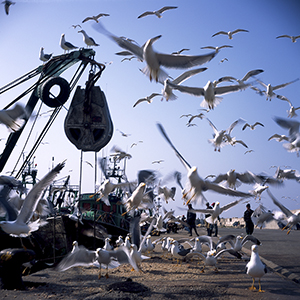
One morning, I was walking along on the outer edge of the seashore, and I came across the fishing docks of Essaouira. The place was lined up with tons of fishing vessels of all kinds, many of them moored because of a wind storm the day before. A few fishermen did manage to make their way through the storm, and began to arrive with their catch from the previous day. Of course this attracted the attention of hundreds of seagulls.
I was at first walking along the outer edge of a high wall that surrounded the main docks to get an overall wider shot of the action.
However, as we all know, being ‘down in the pits’ is a better way to get a good 3D shot. So, I climbed down to get closer, and whoosh! I was surrounded by seagulls! Prime 3D action! This one I shot with my Sputnik, on Fuji Provia 100f.
If you get a chance to visit Morocco, Essaouira is a great place to go, especially within the walls of the medina.
Ayutthaya is a city just 40 minutes north of Bangkok by train in Thailand. The town itself is not too impressive, but the ruins of old Ayutthaya, are fascinating. Ayutthaya was once the capital of Thailand, or Siam. It’s inner cities, surrounded by water moats, can be navigated by renting a bicycle for just a few dollars a day. Lots of biking is needed to cover all of the grounds, and at least 2 days are needed to really take it all in.
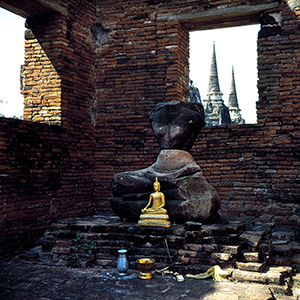
While exploring the city, you come across multiple Buddhist statues, most of them being headless. The head of Buddha was always redeemed as being highly sought after for it’s spiritual properties, so it was often stolen. The one I photographed was no exception. There are also notable spots where fire destroyed some of the structures during the sacking of the city by the Burmese, back in 1767. Ayutthaya was one of my favorite cities in Thailand, and one of the most memorable. In fact, I named our rescued Siamese cat after it. The name suits her well.
Overall, Ayutthaya was a great place to photograph in 3D. Tons of little alleys, and corridors of ruins. I shot this with my Sputnik, on Fuji Provia 100f.
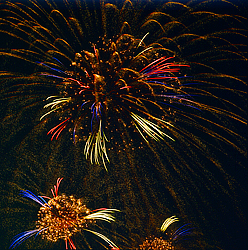
Independence Day fireworks above Seattle’s Lake Union, July 2017
One of my best all-time fireworks shots thanks to all the “sparkly shit!” There’s something special about the depth in this shot, which got a lot of ooohs, ahhhs, and long looks at the 2017 NSA Convention. Shot with Hasselblads separated by 40 feet and outfitted with 150mm lenses.
This year (2018) I aimed my cameras high based on the height of the fireworks from last year. That turned out to be sub-optimal, as they put on a “low show,” and I didn’t get nearly as many shots as I might have. I’m thinking next year I may try to go wide and capture the whole scene, with the barge and city background.
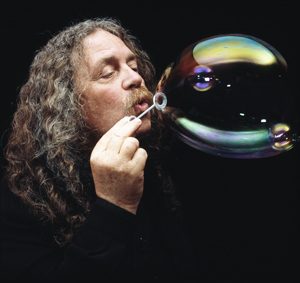
One of the stalwarts of the Moisture Festival is my good friend Tom Noddy, who does an act with soap bubbles. Yes, you read that right. Tom performs all over the world and his act can include caterpillar bubbles, yin yang bubbles, tornado bubbles, a carousel bubble, a bubble tetrahedron, a bubble cube, a bubble dodecahedron, (long time members of the folio have probably seen a number of those!) all delivered with a patter that he’s worked for probably 40 years. When Johnny Carson had his anniversary special with highlights from the last 25 years, a clip of Tom was included. Here he’s creating a “Galactica Bubble” in my living room.
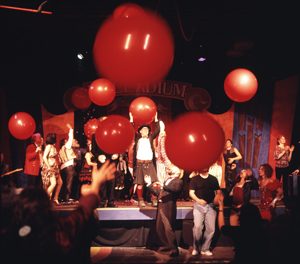
Seattle’s Moisture Festival has grown to be the largest comedy/variety festival in the world. (Perhaps if they had known that when they started, fifteen years ago, they would have given it a different name.) It grew out of a collaboration of performers on the left coast vaudeville circuit and other performers from around the states and around the world. One of the inspirations for the festival was a cabaret run by the great German clown, Hacki Ginda.
I was once part of that vaudeville circuit, and many of the folks in this shot are friends of mine. This was shot a few years ago at the end of the festival, and that’s Hacki Ginda at center stage. Also pictured in the back, sporting a beard, is the great American clown Avner Eisenberg, aka Avner the Eccentric, who years ago did a one man show on Broadway to critical acclaim. The Moisture Festival has very little money to pay performers and yet they come from all over the world to participate.
 Seattle’s Moisture Festival has grown to be the largest comedy/variety festival in the world. (Perhaps if they had known that when they started, fifteen years ago, they would have given it a different name.) It grew out of a collaboration of performers on the left coast vaudeville circuit and other performers from around the states and around the world. One of the inspirations for the festival was a cabaret run by the great German clown, Hacki Ginda.