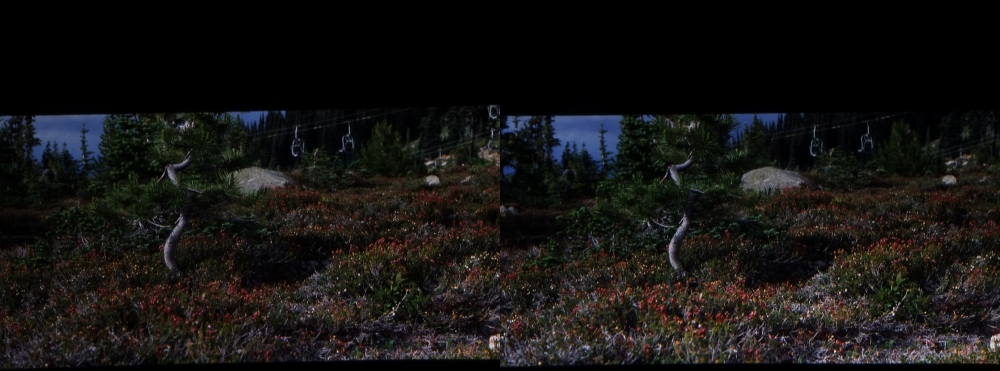
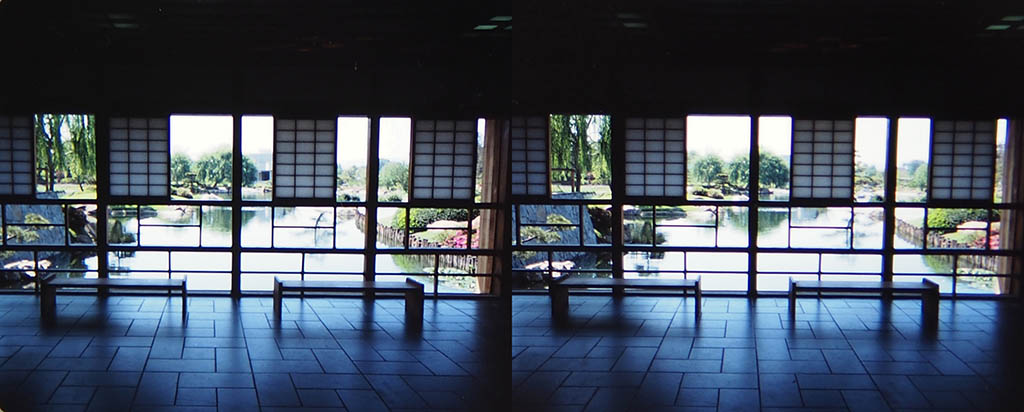
Primary Colour Condos near the Vancouver Canucks building in the previous slide. Rather contrasty light.
Vancouver Canucks
Mirror Portrait
This self portrait of my wife Marie-Claude and me plays a bit more on the theme of mirrors. This time I chose a mirror with a very visible frame to emphasize its presense. The larger size allowed for greater stereo overlap within the mirror itself compared to the smaller mirror used in the previous set.
Original slide shot in Montreal in the gardens of St. Joseph’s Oratory on September 16th, 2012 with a tripod-mounted Heidoscop (as you can see) using Provia 400X exposed at 1/60th at f25.
Saint Brother André
This photograph was taken in the small chapel above which Saint Brother André lived in Montreal, an icon of whom can be seen in the mirror. He led the construction of the huge St. Joseph’s Oratory, and the plaques of thanks to Saint Joseph can be seen on the back wall behind the crutches left by pilgrims. Here is a link: http://www.saint-joseph.org/en_1033_index.php
Original slide shot September 16th, 2012 with a tripod-mounted Heidoscop using Provia 400X exposed for 3 sec. at f25
Microphones
OOOH…..3-D
Capital Peak at Palo Duro Canyon State Park, Texas
El Coronado Visitor Center Palo Duro Canyon State Park, Texas
Palo Duro Canyon State Park opened on July 4, 1934 and contains 29,182 acres of the scenic, northern most portion of the Palo Duro Canyon. The Civilian Conservation Corps of the 1930’s constructed most of the buildings and roads still in use by park staff and visitors.
The Canyon is 120 miles long, as much as 20 miles wide, and has a maximum depth of more than 800 feet. Its elevation at the rim is 3,500 feet above sea level. It is often claimed that Palo Duro Canyon is the second largest canyon in the United States. The largest, the Grand Canyon, is 277 miles long, 18 miles wide, and 6,000 ft. deep.
Palo Duro is Spanish for “hard wood”. The photo was taken from the roof of our CCC constructed cabin located on the rim of the canyon. Only 3 cabins have a rim “view”. I am fascinated by the CCC work and visit and/or stay in CCC constructed cabins whenever we can.
Bastrop State Park #2
I provided all the relevant data in the previous post on Bastrop State Park. 2011 Texas experienced a severe drought, over 300 million trees died. My photos do not begin to depict the severity of the wildfire in the park. The park will take decades to reco
ver. The Lost Pines of Texas near Bastrop are important as they are the westernmost edge of the species’ natural range.
All photos were shot with the TL120 and I used either Provia or Kodak 100. And they were handheld using natural light. F/stop not recorded nor remembered.
Bastrop State Park, Texas: Crispy Sign

The fire ignited on the afternoon of September 4, 2011 near Bastrop, Texas with high winds that knocked drought-weary trees into power lines (Bastrop is about 30 miles southeast of Austin). The blaze created a 16-mile-long front line and galloped at 5 miles per hour, speeding through treetops and jumping state roads. It took 250 firefighters from around the country and 160 fire trucks and other equipment three days to contain the fire. The fire devoured 32,400 acres and destroyed nearly 1,700 homes. The endangered Houston toad was believed to have lost the vast majority of its habitat in the fire. The sign in this photo talks about the Houston toad habitat. The irony is that the sign, in the upper left hand corner, says “Enter with care”. This is in Bastrop State Park where the fire consumed 96% of the park which was home to the loblolly pines, known as the lost pines. The park is slowly recovering. My photo, taken in November 2012, shows where the underbrush has already made a quick comeback. I added a photo of the fire, not taken by me.
All in one place
Today, we’re going back to the ice but we’re not going to move much once we get there. All of the images here were made within 50-feet of each other. The subject is a fairly stable ice cave. I say fairly because it was created by an active creek so there is water flowing into it. The ground is mud, silt, ice, and gravel and is sliding into the cave and under the glacier. The ceiling is made of ice and is full of mud, silt, and gravel and is falling onto the floor. While I was working, some nice ladies stopped in to visit the cave. I used my Fuji to get a set-the-scene snapshot.
Just inside the cave, the layers of the ice are obvious. The younger ice is above, the older ice is denser and is funneling the melt water out to the edge. The running water has carved a Deep V in the ancient ice. The mud and sand is trapped between the layers of ice and is being washed down and dropped on the floor. When working under the ice, the water running down your back is really mud (of various dilutions).
A little to the right, and closer to the ice, In the Groove better shows the layers in the ice and the sand and silt trapped between them. We can also see melt water pouring in to join the creek farther inside the cave.
Farther in the cave but looking a little up, we can see Below the Surface(BW). There is sand and silt embedded inside the ice, and the layers are evident from the back just as well as the front. (Now’s a good time to wish we had carried a helmet with us. The roof is melting, remember?) Finally, we can move a little farther in and get in close. That sand in there has been trapped in the ice for a couple hundred years. It’s just itching to get out so it can slide down into my camera.
![]() Below the Surface (BW) |
![]() Below the Surface |
All images were created with a tripod mounted TL120-1. I don’t record exposure times but the fastest time used was 1 second. They were shot on Provia 100F, Provia 400X, or Ilford HP5.
Nugget Falls Revisited
After visiting Nugget Falls, and seeing the other visitors on that cold November day, I started thinking about the presence and absence of the camera-toting tourists.
With that idea, I returned to Nugget falls in the height of the tourist season to try to capture some Alaskan Wildlife.
I approached the project in two ways. In the first, I went among the tourists. I openly carried my camera and snapped pictures as I saw fit. I didn’t try to be obscure or secretive, and I my TL120-1 was certainly not discrete. I was able to capture some characteristic tourist activities. These included primping for the camera, chimping the group shot on the camera, bickering over the camera, and arguing over the correct way to operate the camera. You get the idea. I fit right in.
In the second case, I set up a blind on a common game trail. I tried to get my 20′ air-release to work, but it failed me and I was forced to work with a 10″ cable release. I aimed the camera, set its exposure, and settled back onto a boulder. By kicking back on the rock with my arms crossed, I was able to hold the cable release in my fingers and trip it when I felt the scene before me was set. Too bad the TL120 lacks a motor advance or I wouldn’t have needed to get up and break my repose. One person called me out on the rig he spotted in the rocks and correctly identified the device as a “big stereo camera”.
Return to Nugget Falls
Back in loop-17 (2005?), I contributed a couple of images taken from midway up Nugget Falls on the Mendenhall Lake. I liked the subject and wanted to try with wider lenses.
In November 2011, I went back with my son and we both shot some images. A couple of his shots are provided here to help set the scene. I was using my TL120-55, he was using a Canon 7D.
![]() |
![]() |
It was November, so the lake was just starting to freeze and the sun was low even at mid morning. He climbed up the scree pile beside the falls while I loaded film and prep’d my gear on more stable ground. Then I came up shot a roll looking across the face of the falls, across the freezing lake, and into the powered sugar covered mountains.

Stuart caught me while I was framing, so after I had shot my scenics and was climbing down, I turned the camera on him. I had already slung my tripod for the descent, so this was a hand-held shot (with neck strap).
![]() |
![]() |
The other visitors to the falls were a fortuitous accident. But when I saw them down below, I stalled my framing for a few seconds hoping they would spread to better fill the frame. My gamble paid off and I was please with their contribution to the image.
Wild and Tamed
The work of David Lee of Soquel, California
Ava B 202

Date: July 2012
Tech:
taken with the Sputnik on loan from Chuck Holzner on Fuji Astia RAP100F, 1/25 sec., f22. This is the original slide.
Notes:
Here we have my new model Ava reclining amongst some rocks in the James River at Lynchburg, VA. All summer I had wanted to find a nice spot for photographing a nude in water. This place wasn’t quite what I’d hoped for, but sometimes you just have to play the cards you are dealt. The remainder of the summer was taken up with NSA prep (thanks to Chuck for helping me mount MF3d for a month!), and thereafter a trip to Germany. Water pictures must now wait another year. Pray that the film processing remains available through 2013!